
Arkadi Monastery History: What Happened in 1866 and How to Visit Today
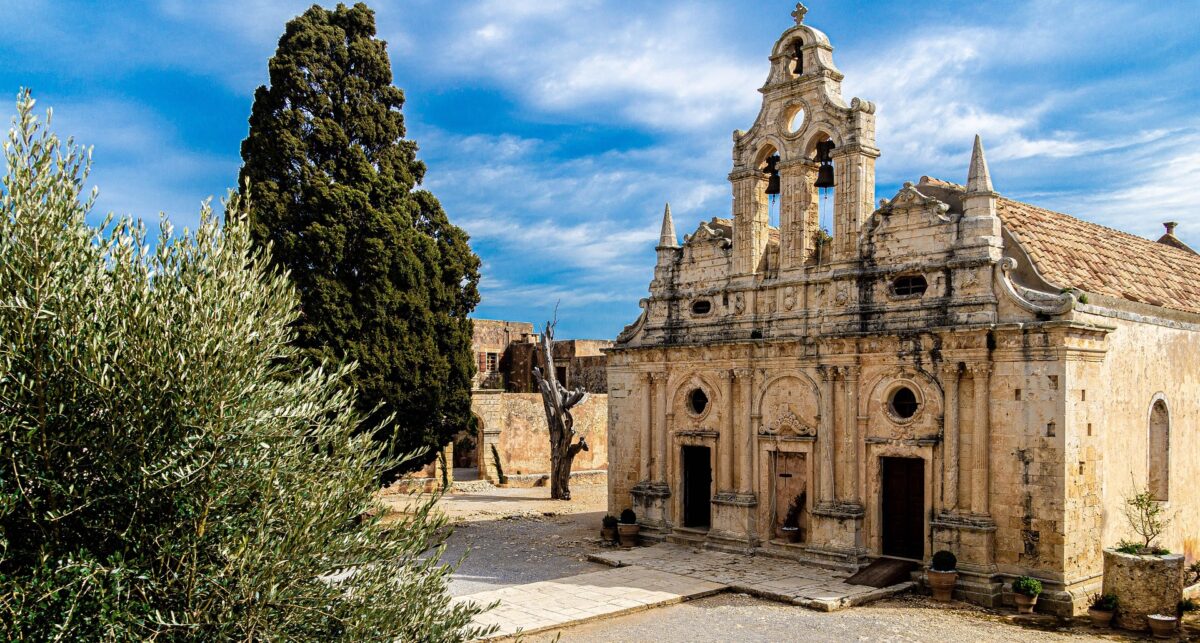
Arkadi Monastery history turns on three days in November 1866.
By the usual count, 964 people were inside these walls, and most of them were women and children from nearby villages. Only a handful walked away free. This guide tells that story through the people who were there, then shows you the monastery as it is now: a working Orthodox house on a quiet plateau, with a Venetian-era facade, a roofless powder room, and a small museum. You will also find what you need to plan a visit, from opening hours and the entrance fee to the dress code and the drive from Rethymno. We have tried to write it the way we would speak to you at the gate, calmly and with care for the place.
Quick answer: At Arkadi Monastery, Cretan rebels and local families held out against a far larger Ottoman army from November 7 to 9, 1866. When the gate fell, the defenders set the powder magazine alight rather than surrender. The blast killed those inside, including women and children, along with many of the attackers. The monastery is well worth visiting today. Allow about 90 minutes, and cover your shoulders and knees.
The Arkadi Monastery tragedy took place from November 7 to 9, 1866, during the Cretan revolt against Ottoman rule. About 964 people, most of them women and children from nearby villages, had taken refuge in the monastery near Rethymno when an Ottoman army of roughly 15,000 surrounded it. After the gate fell, the defenders ignited the powder magazine rather than surrender. By the most cited count, 846 people died and 114 were taken prisoner.
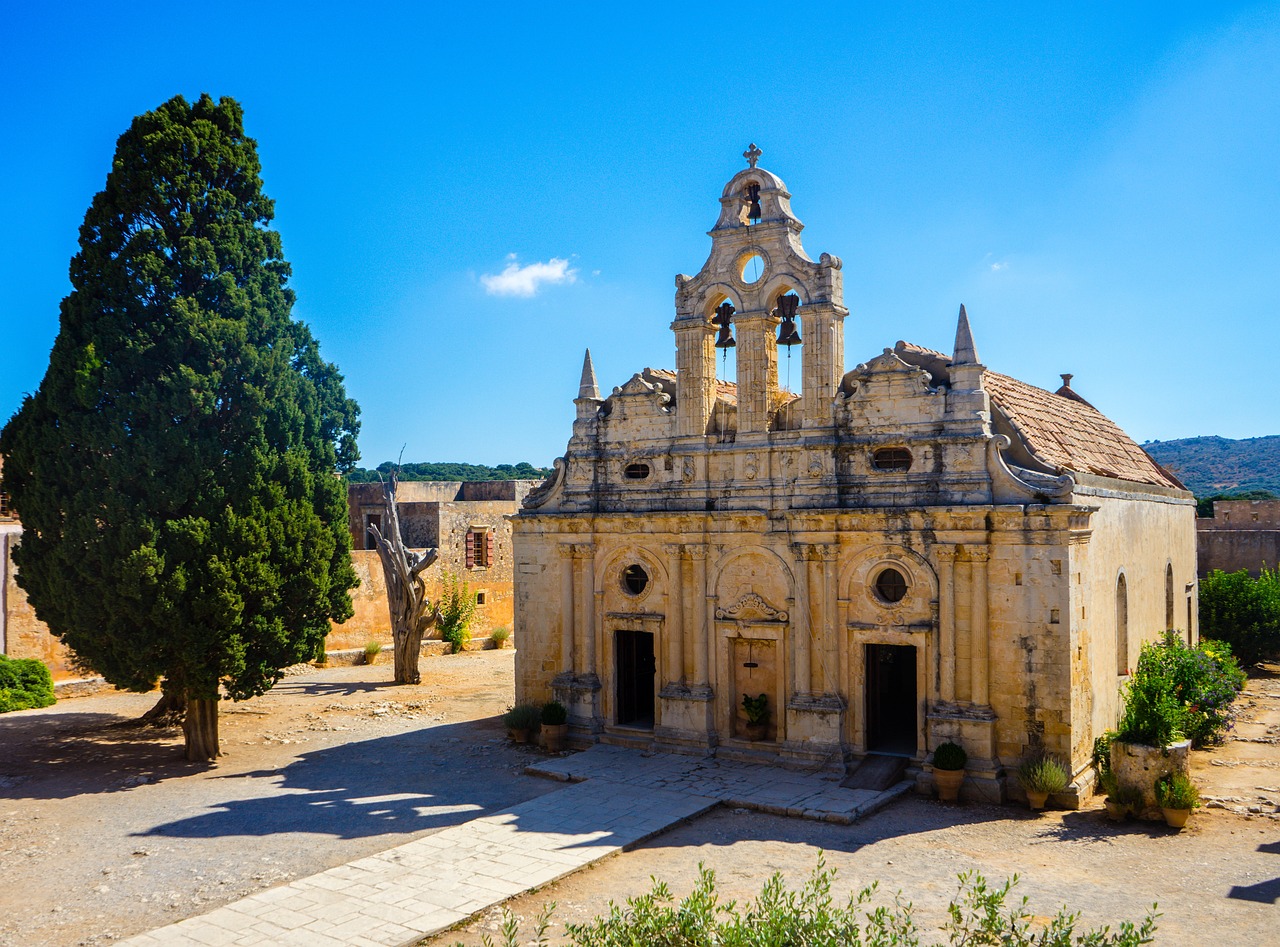
Image by Leonhard Niederwimmer from Pixabay
The Arkadi Monastery Story: What Happened in 1866
The siege lasted only two days of open fighting, but the choices behind it began months earlier. It helps to start there.
Why the Monastery Joined the Revolt
Crete had been under Ottoman rule since the 1600s, and by 1866 Cretans were rising again, this time calling for union with Greece. On May 1 of that year, about 1,500 rebels gathered at Arkadi and chose their regional representatives. The abbot, Gabriel Marinakis, a man of about 40 from the village of Margarites, became president of the revolutionary committee for Rethymno. The Ottoman authorities ordered the committee out. It stayed.
That autumn, the officer Panos Koronaios came to inspect the monastery and judged that it could not be defended. The abbot and the monks disagreed. Koronaios left, naming Ioannis Dimakopoulos as commander of the garrison. Arkadi would stand on its walls and on the people behind them.
November 7: Families Behind the Walls
Families from the surrounding villages had come up to the monastery for safety. By November 7, the count stood at 964 people: 325 men, 259 of them armed, and the rest women and children. During that night, Ottoman troops reached the plateau. Estimates put the force at about 15,000 soldiers with some 30 cannons, under the overall command of Mustafa Pasha.
November 8: The First Day of Fighting
The Ottoman commanders demanded surrender. The reply, by local tradition, was to raise the banner of the Transfiguration, which you can still see in the museum. The assault came at the western gate, which the defenders had barricaded, and it lasted all day.
Women carried water and ammunition to the men on the walls. Seven fighters held the windmill outside the gate until the attackers set it on fire and killed them. After dark, heavy cannons were hauled up from Rethymno. Two messengers slipped out to look for help, but the roads were blocked and none came. Inside, a liturgy was held, and families took Holy Communion.
November 9: The Gate and the Powder Magazine
The cannons broke the western gate, and Ottoman troops entered the courtyard. Ammunition was running out. Thirty-six fighters trapped in the refectory were killed there. Most of the women and children had gathered in the powder magazine, a former wine cellar.
That evening, the powder was ignited. The blast killed those in the room and many of the soldiers at its door. Powder in a second room was damp and only partly exploded. Dimakopoulos and the last defenders are said to have surrendered on a promise of safety and been killed the next day.
Greek tradition gives the act to Kostis Giamboudakis, and his statue stands in Rethymno today. Other accounts, including a consular report from that same month, name different men, and historians still debate the point. The abbot’s end is also uncertain. Tradition places him in the explosion, while most historians think he died during the fighting.
What the Numbers Tell Us
The figures most often cited for the Arkadi Monastery tragedy are these: 964 people inside, 846 dead, 114 taken prisoner, and three or four who got away. The 964 figure comes from the account of Kakoudakis, one of the two main sources for the siege, and this breakdown is the one repeated in most reference histories. Other versions differ. Victor Hugo, writing from abroad, gave 197 men and 343 women, plus children, and some pages print 864 dead where others print 846. Ottoman losses are usually estimated at about 1,500, though reports vary widely. We share the numbers to give a sense of scale, knowing they are careful estimates and not a final record.
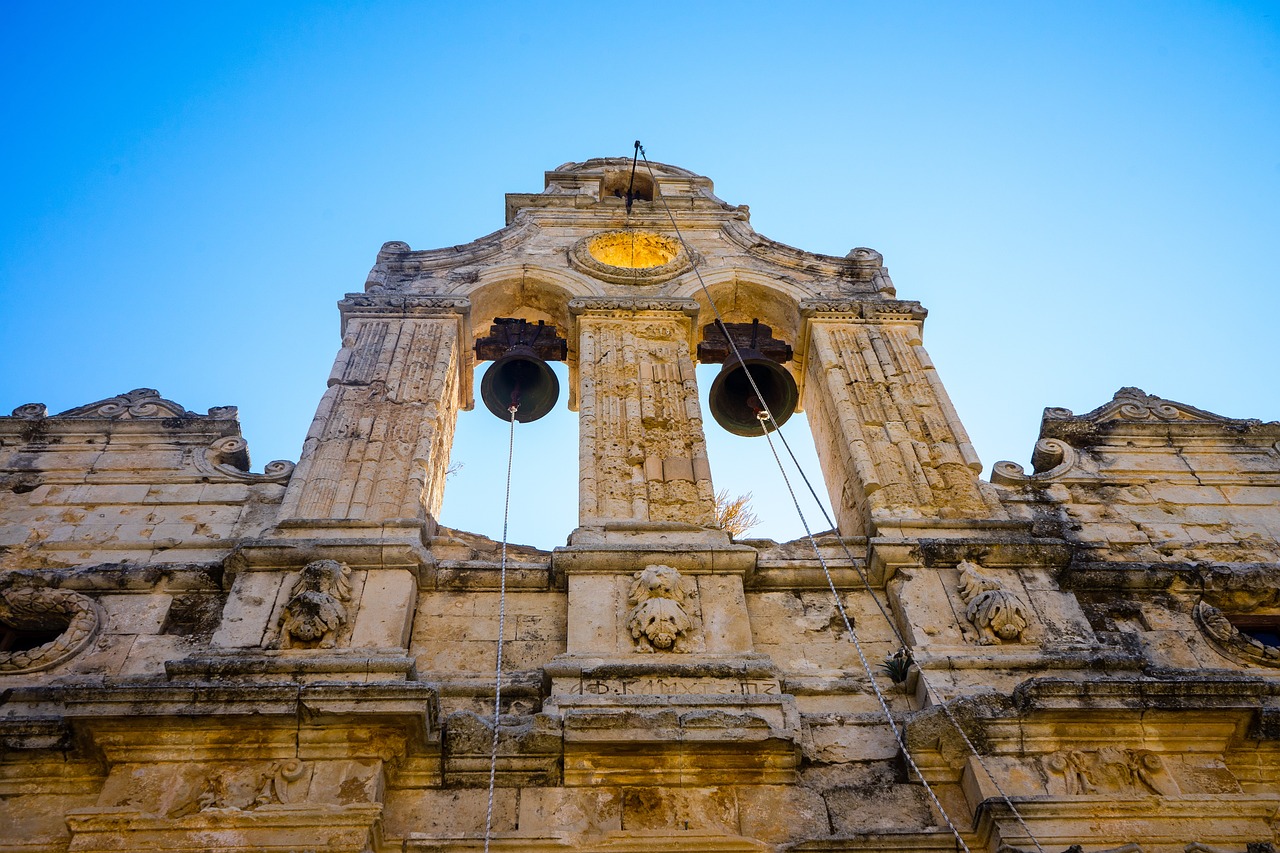
Image by Leonhard Niederwimmer from Pixabay
The Women and Children of Arkadi
Most of the people inside Arkadi were women and children, yet most retellings keep the men at the center. It is worth widening the view. Crete has long kept women near the heart of its sacred memory, from the women of Minoan Crete onward, and the women of 1866 belong in that long line of remembering.
The one woman most often named is Charikleia Daskalaki of Amnatos, the nearest village. Greek accounts say she led the women inside the monastery, and survivors remembered her running to the fallen to gather weapons and ammunition for the fighters. She lost three sons in the war of 1866. She lived through the siege, was held prisoner in Rethymno, and later moved to Athens to live with relatives. It is said she never spoke about what happened to her in Crete. You will find her bronze bust near the former windmill at Arkadi, and another in Amnatos.
The prisoners were taken to Rethymno. Women and children were held for about a week at the church of the Presentation of the Virgin, and the men for about a year. The Russian consulate stepped in to ask for better conditions.
One question stays open: did the women choose? Some accounts say they agreed to die together rather than face capture. Others say the decision was made by men and told to them. Almost none of their own words survive. What we can say is that they were not bystanders. They carried water and ammunition, some gathered weapons under fire, and they deserve to be remembered as people who faced the same night as everyone else.
Why Arkadi 1866 Mattered Beyond Crete
No chapter of Arkadi Monastery history reached further than this one. News of Arkadi 1866 traveled quickly, and it changed how Europe and America saw the Cretan cause. Victor Hugo wrote letters of support that were printed in the newspaper Kleio in Trieste. “The cause of Crete is that of Greece,” he wrote, “and the cause of Greece is that of Europe.” Giuseppe Garibaldi praised the Cretans, and Garibaldian volunteers came to fight on the island. In the United States, public sympathy grew, and in 1868 the House of Representatives debated the question before voting not to intervene.
The revolt ended in 1869 without independence. Crete gained autonomy in 1898 and joined Greece in 1913. Yet Arkadi remained the event Cretans pointed to when explaining what freedom had cost. In Greek it is called the Holocaust of Arkadi, using an older word for an offering burned whole. The 2026 commemorations also speak of the “Arkadian self-sacrifice.”
Arkadi Monastery History at a Glance
- 14th century: an inscription shows an earlier church on the site, dedicated to Saint Constantine.
- 1573: Abbot Klimis Hortatzis reorganizes Arkadi as a communal monastery.
- 1587: the date carved on the clock of the church facade.
- 1687: the refectory is built on the north side of the courtyard.
- May 1866: rebels gather at Arkadi at the start of the Cretan revolt.
- November 7 to 9, 1866: the siege and the explosion of the powder magazine.
- 1910: the windmill takes its present form as a memorial ossuary.
- 1933: the monastery museum is founded.
- 2016: the 150th anniversary, marked by a Greek 2 euro coin.
- 2026: the 160th anniversary.
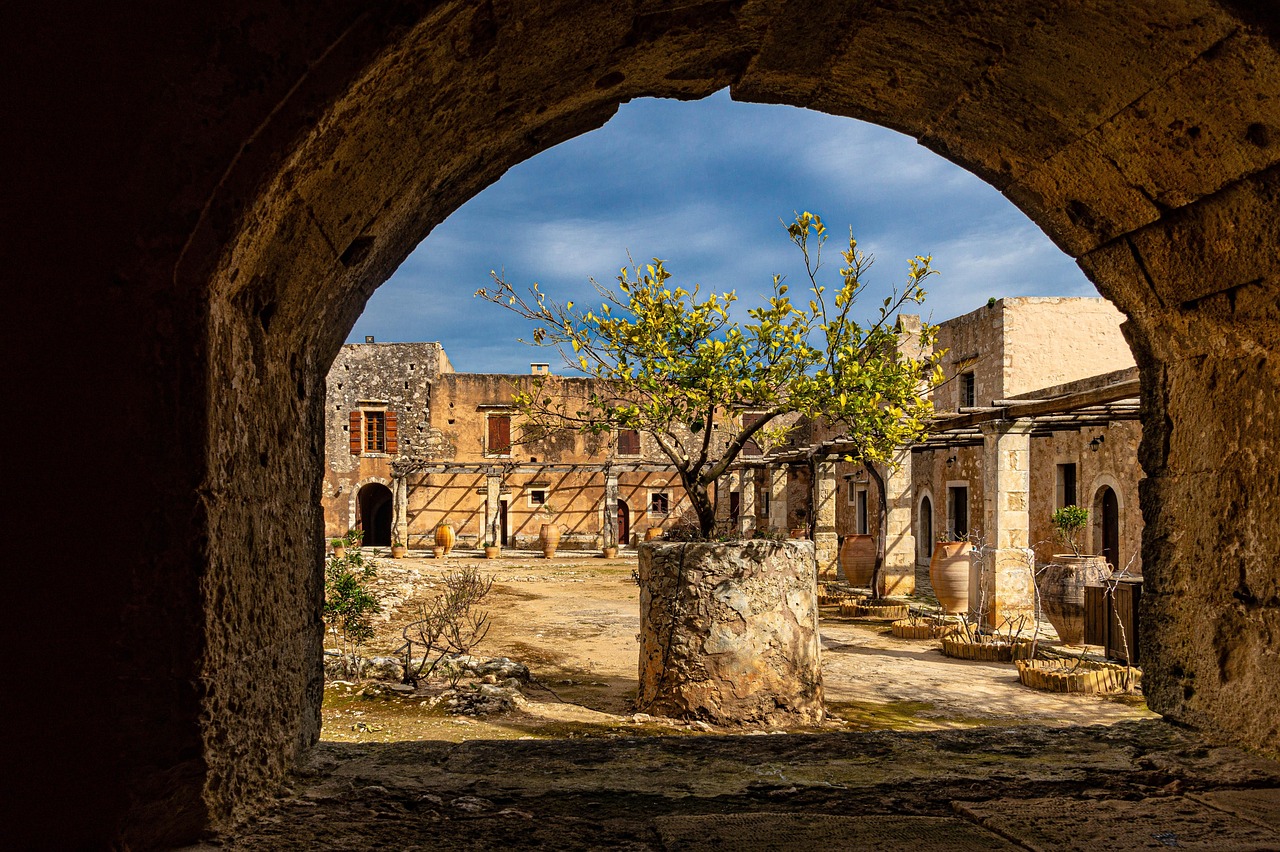
Image by Murat Demirel from Pixabay
A Living Sacred Place: What to See at Arkadi Monastery Crete
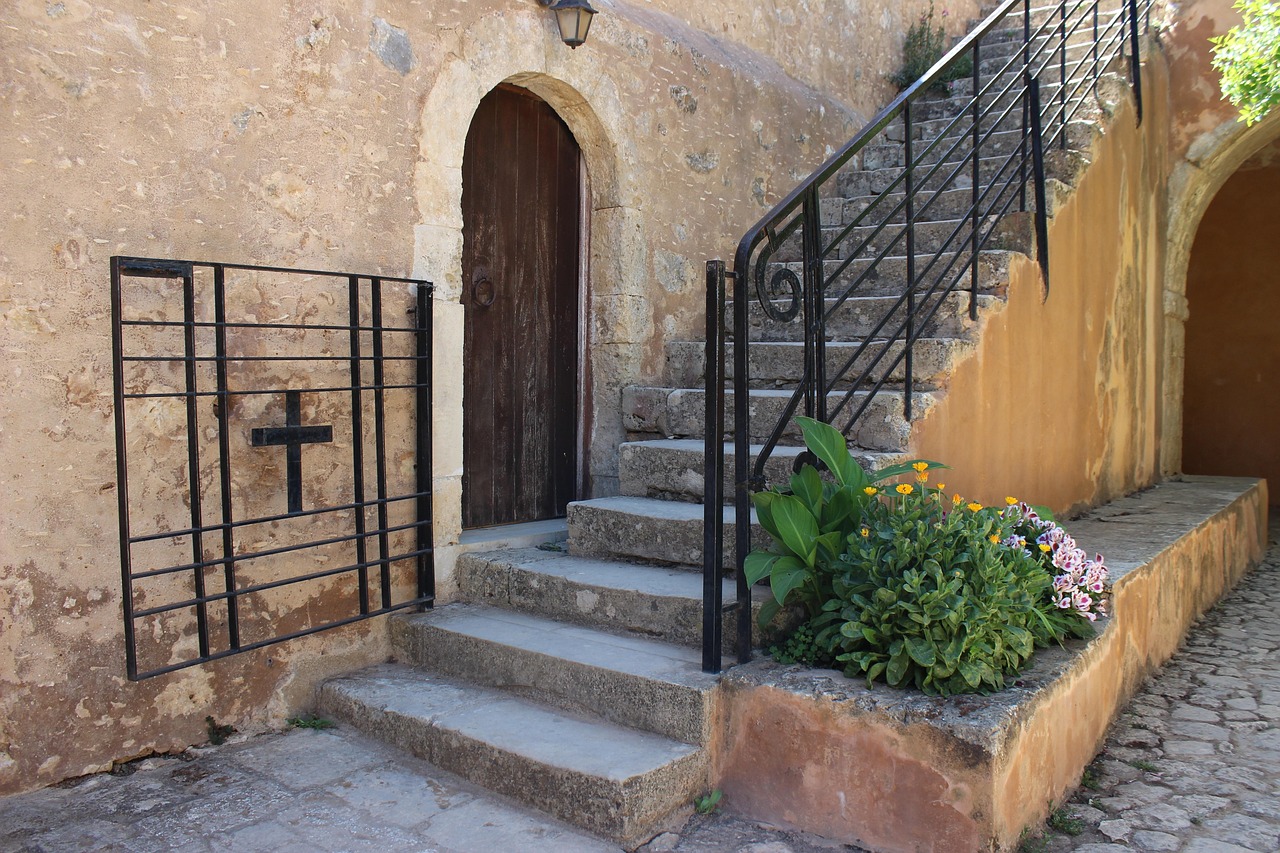
After a story like this, many visitors expect a ruin. Arkadi Monastery Crete is instead a working Orthodox house, home to a small community of monks. It sits at about 500 meters (1,640 feet) on a fertile plateau at the foot of Psiloritis. Services are still held here, and candles still burn a few steps from the marks of 1866.
The early chapters of Arkadi Monastery history are uncertain. Tradition credits a Byzantine emperor, either Heraclius or Arcadius, and others credit a monk named Arkadios, which fits how many Cretan monasteries were named. In the 16th and 17th centuries, it was a place of learning, where monks copied manuscripts and ran a gold embroidery workshop whose vestments were sold abroad.
The Venetian-Era Facade
The west front of the church is the image you will know from photographs. Built while Crete was under Venetian rule and dated 1587 on its clock, it pairs Corinthian columns and arches with a clock and obelisks above. Scholars see the influence of the Renaissance architects Serlio and Palladio. It looks almost Italian, set here among olive trees and Cretan stone, and that blend is part of its beauty. If you enjoy these buildings, Arkadi leads our list of the most impressive churches in Crete.
The Church
The church has two aisles. The north aisle is dedicated to the Transfiguration, and the south to Saint Constantine and his mother, Saint Helen. Fire destroyed much of the interior in 1866, including the old carved altar screen, so what you see inside was restored after the siege. The building is quiet and cool, with the smell of beeswax in the air. Stay a few minutes before you move on.
The Powder Room and the Refectory
The roof of the powder room never came back. Open to the sky, with one surviving wall and a memorial painting, it is the place where most visitors fall silent. There is little to look at, and that feels right.
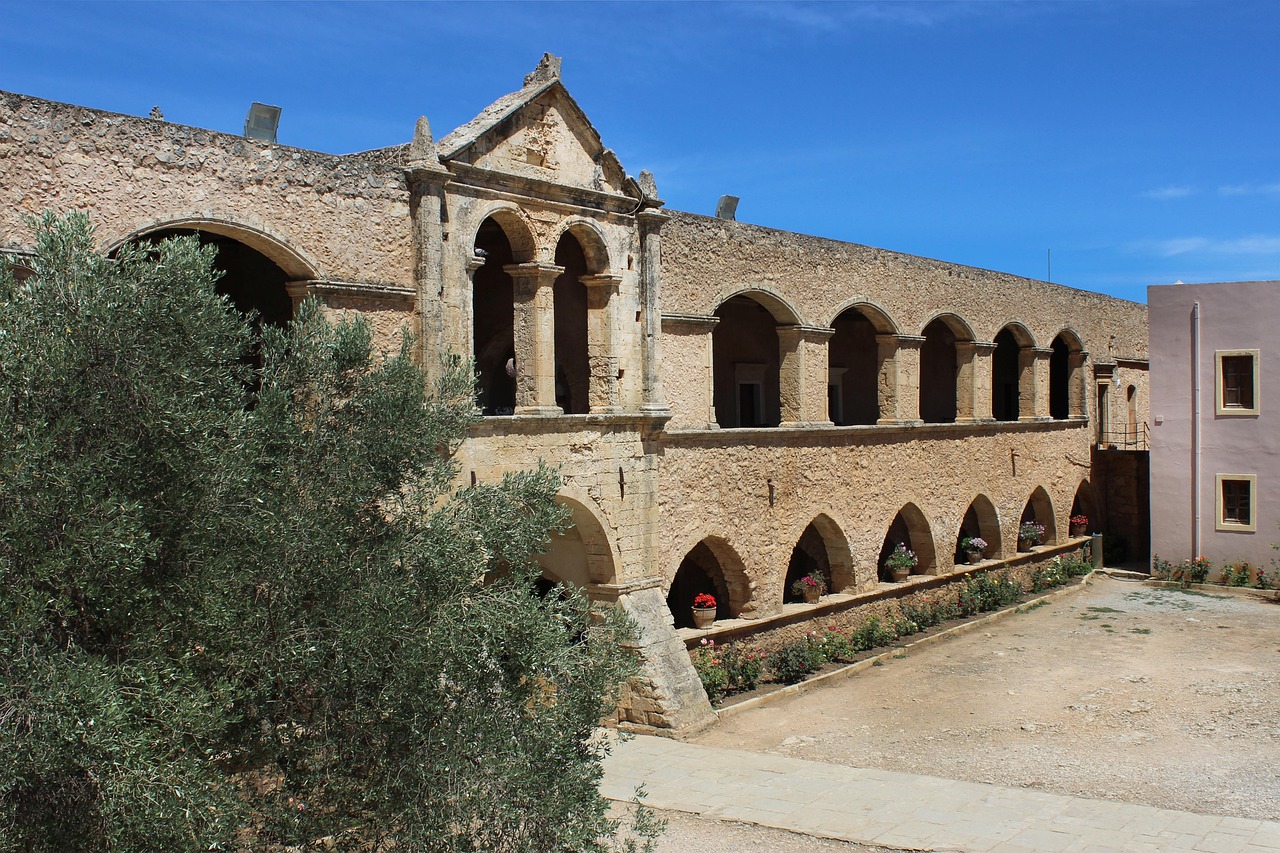
The refectory still holds its long wooden tables, and you can see the sword marks in them. Out in the grounds, an old cypress still shows the bullet damage of the siege.
The Museum
The small museum, founded in 1933, is in the southwest wing, and it tells Arkadi Monastery history through objects. Look for the banner of the Transfiguration carried in 1866, a carved fragment of the altar screen that survived the fire, and a gold-embroidered vestment from 1681. There are also post-Byzantine icons, manuscripts, weapons from the siege, and a gallery added in 2016 with paintings inspired by the monastery. For more places like this, see our guide to Crete through its museums.
The Ossuary in the Former Windmill
About 60 meters west of the gate stands the former windmill where the seven fighters died. In 1910 it was rebuilt in its octagonal form as a memorial, and it holds the skulls and bones of those who fell, some with visible wounds. Bronze busts stand nearby, including that of Charikleia Daskalaki. The door is not always open. Even from outside, this is a place to pause, so please do not leave it out of your visit.
Is Arkadi Monastery Worth Visiting?
Yes, Arkadi Monastery is worth visiting, above all if you want to understand how modern Crete sees itself. No other single place on the island holds so much of its memory of freedom. It is compact and easy to reach, and the story gives every room weight and suits travelers who like history and sacred places. It is less suited to anyone hoping for a light stop between beaches, since the mood here is quiet and serious.
Arkadi Monastery Visitor Information
These details change, so please confirm them close to your visit.
Arkadi Monastery Opening Hours
The monastery is open daily through most of the year. The most recent published hours are:
- March and October: 9:00 a.m. to 6:00 p.m.
- April, May, and September: 9:00 a.m. to 7:00 p.m.
- June to August: 9:00 a.m. to 8:00 p.m.
- November: 9:00 a.m. to 5:00 p.m.
Sources disagree on December to February, with some listing shorter winter hours and others listing a closure, so call ahead for those months. On Sundays, the museum opens only after the Divine Liturgy ends.
Arkadi Monastery Entrance Fee
The Arkadi Monastery entrance fee is about 4 euros per adult, and the ticket covers the museum. Older guides list lower figures, and some newer ones list higher amounts, so treat this as a guide and check on the day.
Arkadi Monastery Dress Code
The Arkadi Monastery dress code is simple: cover your shoulders and knees. This is a place of prayer, so skip beachwear, remove your hat in the church, and keep your voice low. Wraps are sometimes available at the entrance, but it is safer to bring your own. Photography is allowed, without flash.
How to Get to Arkadi Monastery from Rethymno
To reach Arkadi Monastery from Rethymno, drive about 23 km (14 miles) southeast of town, which takes 30 to 40 minutes. The road climbs inland through olive groves and villages such as Adele and Amnatos, then runs along a gorge to the plateau. In late autumn, you may see nets under the trees for the olive harvest, which our olive oil experience in Crete article explains. Parking is free, and there is a cafe just outside.
KTEL buses also run from Rethymno a few times a day, taking about 40 to 50 minutes. Timetables change by season, so check with KTEL before you plan around them.
How to Get There from Chania or Heraklion
From Chania, allow about 1 hour 30 minutes by car for the 85 km (53 miles). From Heraklion, allow about 1 hour 30 minutes as well. By bus from either city, change in Rethymno. Arkadi fits well as a stop on a longer drive, as in our Crete road trip itinerary.
How Long to Allow, and When to Go
Allow 60 to 90 minutes, including the museum and the walk to the windmill. In summer, arrive early or come in the late afternoon. Spring and autumn are the most comfortable seasons, as our guide to the best time to visit Crete explains. In November, bring a warm layer, since the plateau is cooler than the coast.
What to Combine with Arkadi
Arkadi sits close to several places that pair well with it, and together they make a full and varied day in the Rethymno hills.
Ancient Eleftherna: This ancient city lies only about 5 km (3 miles) from Arkadi as the crow flies, and it is one of the key archaeological sites in Crete. At its Orthi Petra necropolis, excavators found an eighth-century BC tomb with four women aged from about seven to seventy, and the dig’s director believes the eldest was a high priestess buried with her attendants. The Museum of Ancient Eleutherna displays finds from the site. It closes on Tuesdays and keeps shorter hours from November to March, and the necropolis itself is closed for now.
Margarites: This is the pottery village of the area, and the birthplace of Abbot Gabriel, whose bust stands here. Watch potters at work and stop for coffee in the square. It is among the must-see villages in Crete.
Melidoni Cave: Also called Gerontospilios, this cave was sacred to Hermes and Talos in antiquity. In 1824, some 370 villagers died here in another Ottoman siege, so it pairs closely with Arkadi in mood. It sits north of Margarites, and winter hours are limited. It appears in our guide to the caves in Crete.
If you enjoy walking, a marked route of 9.9 km (6 miles) links Arkadi, Eleftherna, and Margarites along part of the E4 long-distance path. It takes about four and a half hours. There are no springs on the way, so bring water.
November 8 in Crete: The Day at Arkadi and in Rethymno
November 8 is the anniversary of the start of the fighting, and it is one of the most important dates in the Rethymno year. It is a local holiday, so expect some shops and offices in town to close. Flags line the streets, and the morning starts with a liturgy at the monastery. Officials, clergy, and families then gather for a memorial, while the town holds a parade with cultural groups, often in traditional Cretan dress. The Arkadi Games, a sports event held since the 1930s, also take place around the anniversary.
The 160th Anniversary on Sunday, November 8, 2026
This year’s program, published by the Region of Crete, marks 160 years since the siege:
- Saturday, November 7: memorial services at the busts of Abbot Gabriel in Margarites (10:00 a.m.), Charikleia Daskalaki in Amnatos (11:30 a.m.), and Kostis Giamboudakis in Adele (12:30 p.m.), followed by a parade in Adele.
- Sunday, November 8, morning: Divine Liturgy at Arkadi (8:30 a.m.), then a parade in Rethymno (10:30 a.m.) attended by the President of Greece.
- Sunday, November 8, midday: a thanksgiving service at Arkadi (12:00 p.m.), a memorial service at the mausoleum (12:30 p.m.), and a wreath-laying by the President with a minute of silence (12:40 p.m.).
If you are on the island, these are community commemorations, and visitors can usually watch quietly from among the crowd. Dress as you would for church and arrive well ahead of time. With the President attending, expect security, heavy traffic, and limited parking on the Arkadi road. The program does not say how ordinary visits will run that day, so plan your own tour of the museum for another date. Through December 9, the Public Central Library in Rethymno also hosts a free exhibition of newspaper front pages about Arkadi.
Conclusion
Arkadi Monastery history is a story of a small community that refused to give way, and of the women and children who shared its fate. You can read it in the sword marks in the refectory, in the open sky over the powder room, and in the windmill where the bones now rest. It is also a living place, where monks still pray beneath a facade raised nearly 440 years ago.
Give it an unhurried hour or two, dress with respect, and pair it with Eleftherna or Margarites if you have the day. Late autumn is a good time to come, when the plateau is cool and the island is remembering.
If you would like to walk Arkadi with someone who knows its stories, Elissos Travelling Philosophy includes it in private days across Rethymno and West Crete, shaped around your pace and your interests. Get in touch with us, and we will help you plan your time here.
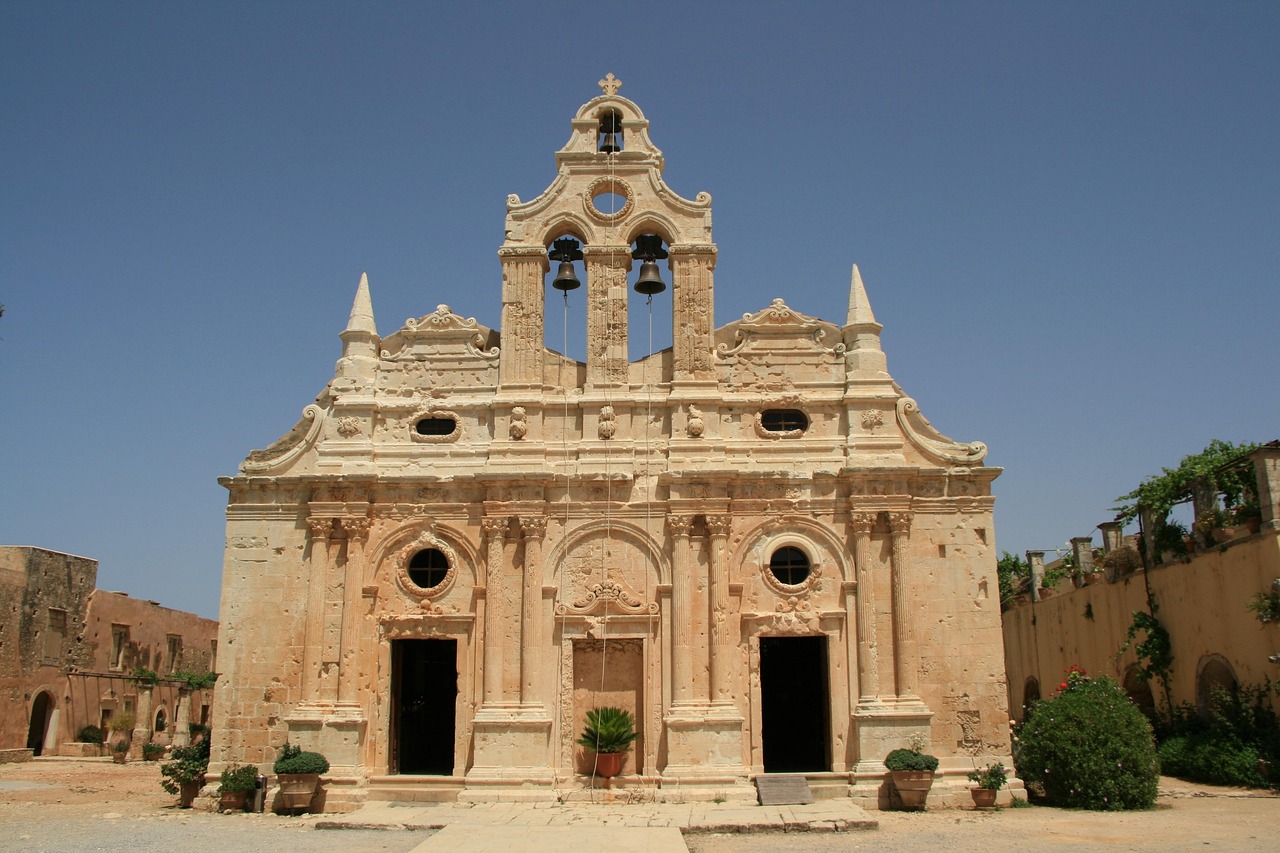
Image by Matthias Lemm from Pixabay
Frequently Asked Questions
What happened at Arkadi Monastery?
In November 1866, during the Cretan revolt against Ottoman rule, about 964 people took refuge in Arkadi Monastery, most of them women and children. An Ottoman army of roughly 15,000 attacked on November 8. On November 9, after the gate fell, the defenders ignited the powder magazine rather than surrender.
How many people died at Arkadi Monastery?
The most cited count is 846 dead out of 964 people inside, with 114 taken prisoner and three or four who got away. Sources differ, and some give 864 dead. Ottoman losses are often estimated at about 1,500.
Why is Arkadi Monastery so important to Crete?
Arkadi Monastery history matters because the monastery is the island’s strongest symbol of its fight for freedom. The events of 1866 drew support from across Europe and the United States for the Cretan cause. The monastery remains a place of prayer and national memory.
Who set off the explosion at Arkadi?
Greek tradition names Kostis Giamboudakis, and he is honored with a statue in Rethymno and a bust in Adele. Some accounts name other men, so historians still debate who lit the powder.
Is Arkadi Monastery a UNESCO World Heritage Site?
No, Arkadi Monastery is not a UNESCO World Heritage Site. You may see it called a “European Monument of Freedom,” a title often linked to UNESCO, but we could not find a public UNESCO record of it.
What are the Arkadi Monastery opening hours?
Arkadi is generally open daily from 9:00 a.m., closing at 5:00 p.m. in November and as late as 8:00 p.m. from June to August. Hours from December to February are less clear, so call ahead. On Sundays, the museum opens after the Divine Liturgy.
How much is the Arkadi Monastery entrance fee?
The entrance fee is about 4 euros per adult, and it covers the museum. Published amounts vary, so check on the day of your visit.
What should I wear to Arkadi Monastery?
Wear clothing that covers your shoulders and knees. Arkadi is an active monastery, so avoid beachwear, remove your hat in the church, and keep your voice low.
How do you get to Arkadi Monastery from Rethymno?
Arkadi is about 23 km (14 miles) southeast of Rethymno, a drive of 30 to 40 minutes. KTEL buses also run from Rethymno a few times a day, taking about 40 to 50 minutes. Check the timetable first, since it changes by season.
Feature Image by Murat Demirel from Pixabay