
The Minotaur of Crete: The Myth, the Labyrinth, and What Was Real
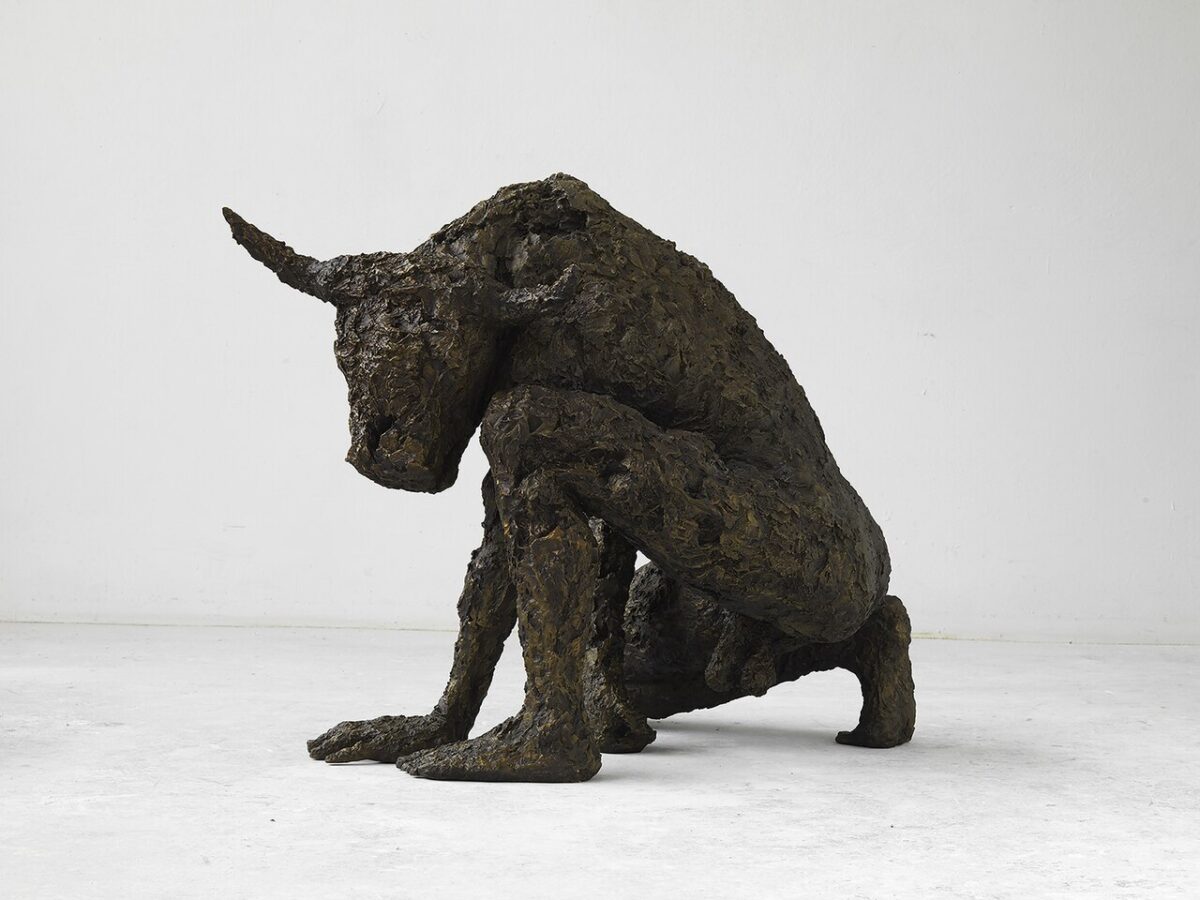
Most travelers know the Minotaur of Crete before they ever land on the island.
He is the half-man, half-bull who waited at the center of a maze. Athens sent young men and women into that maze as tribute. Even today, people on Crete tell the story with a small smile. From there, they point you toward Knossos, where the myth and the stones meet.
This guide tells the whole Minotaur story, including the parts that usually get cut. Along the way, it gives Pasiphae and Ariadne their own space. It explains the double axe, the sacred bull, and the goddess behind both. Finally, it answers the questions people ask most. Where was the Labyrinth? Was the Minotaur real? And what can you still see in Crete today?
Quick answer: The Minotaur of Crete is a mythical half-man, half-bull creature. According to the myth, he lived in the Labyrinth of King Minos at Knossos. He was never real. Yet his story grew from a real Bronze Age world of bull rituals, double axes, and a maze-like palace that still stands near Heraklion.
Who was the Minotaur? The Minotaur was a creature of Greek mythology with the body of a man and the head of a bull. He was born on Crete to Queen Pasiphae, wife of King Minos. According to the legend, Poseidon made her desire a white bull that Minos refused to sacrifice. His given name, however, was Asterion. To conceal him, Minos locked him inside the Labyrinth, a maze built by the craftsman Daedalus at Knossos. Athens sent seven young men and seven young women to the Labyrinth as tribute. Eventually, the Athenian hero Theseus killed the Minotaur and found his way out with a thread from Ariadne.
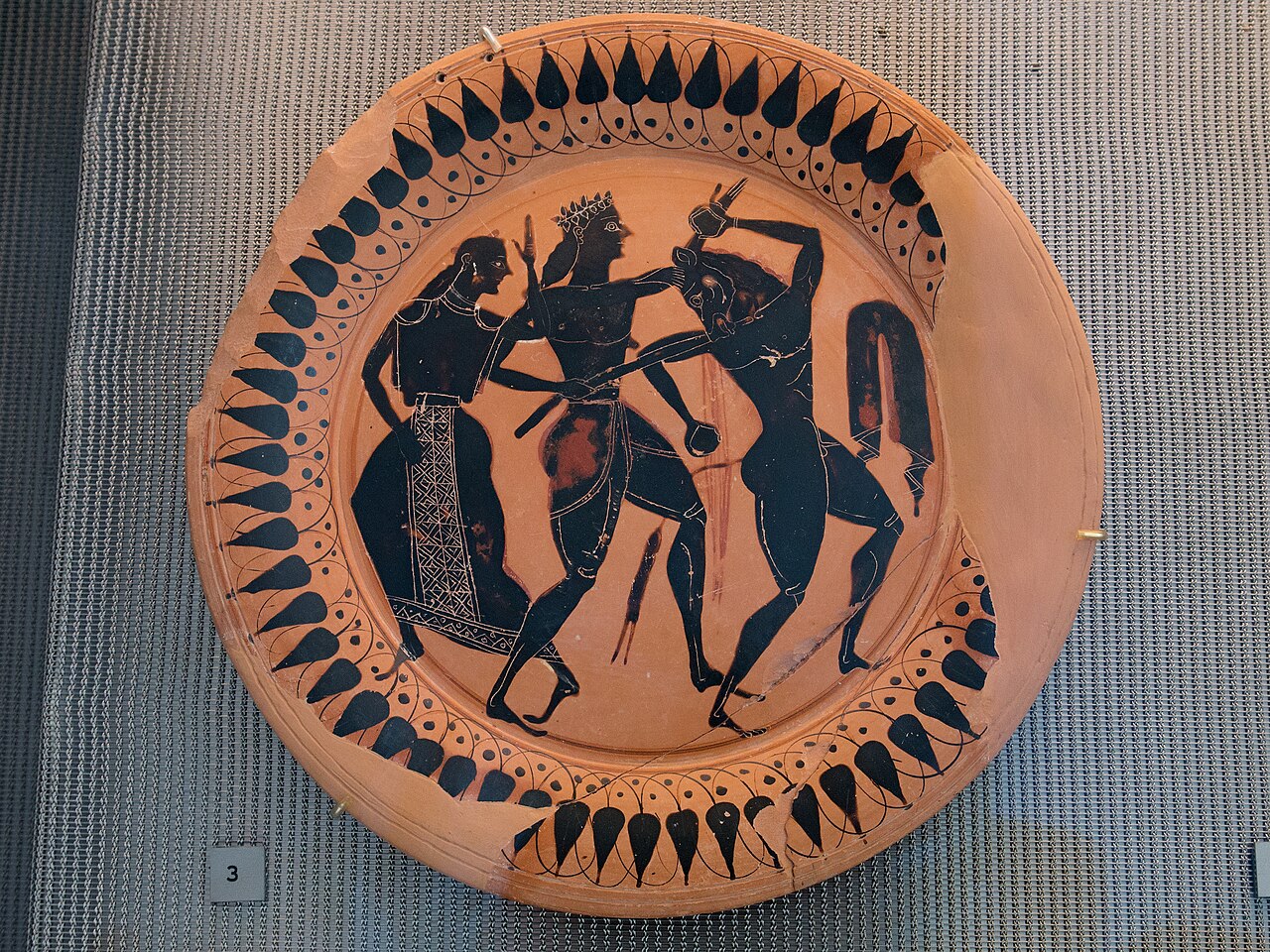
Black-figure plate depicting Theseus and the Minotaur, painted by Lydos (550–540 BCE), Acropolis Museum, Athens. Photograph by Zde, via Wikimedia Commons. Licensed under CC BY-SA 4.0. No changes made.

Who Was the Minotaur?
The Minotaur was the son of a Cretan queen and a sacred bull. His name comes from the Greek Minotauros, «the bull of Minos.» Ancient writers also used his own name, Asterion, which means «of the stars.» This detail matters because of his family lineage. Indeed, it links him to the sky and to his mother’s family, who descended from the sun.
Greek vase painters almost always showed him the same way: a strong human body with a bull’s head and tail. By contrast, river gods were often painted in the reverse form, who often appear as bulls with human faces. As a result, the Minotaur was something new and harder to place. He belonged to neither the animal world nor the human one.
In the Minotaur myth, Crete is the center of power. Minos rules the sea, Athens pays tribute, and the island holds the secret at the heart of the maze. In turn, that setting tells us something. The Greeks who told this story remembered Crete as older, stronger, and stranger than their own cities.
The Minotaur Story, From the Sea Bull to the Thread
The Minotaur story unfolds in four parts. Moreover, each part adds a new character, and each one is tied to a place on Crete.
A White Bull From Poseidon
Minos was the son of Europa and Zeus, who had carried her to Crete in the form of a bull. You can read more about Zeus and his ties to Crete in our separate guide. Later, when Minos claimed the throne, he asked Poseidon for a sign. A magnificent white bull rose from the sea. In return, Minos promised to sacrifice it to the god. However, he liked the animal too much and sacrificed a lesser bull in its place.
Pasiphae and the Bull
In response, Poseidon punished the broken promise through the queen. He filled Pasiphae with desire for the white bull. Desperate for help, she turned to Daedalus, the court craftsman, who built her a hollow wooden cow covered in hide. Hidden inside it, she united with the bull. From this union, she bore the Minotaur.
Daedalus Builds the Labyrinth
Minos could not kill the child, and he could not let him roam free. Instead, he ordered Daedalus to build a structure so complex that no one inside could find the way out. The result was the Labyrinth. Thereafter, the Minotaur lived at its center, and Minos used it as a place of punishment.
Theseus, Ariadne, and the Way Out
Minos’s son Androgeus died in Attica, and Minos blamed Athens. Consequently, Athens had to send seven young men and seven young women to Crete. In Plutarch’s account, this happened every nine years, and the youths went into the Labyrinth. Eventually, Theseus, son of the Athenian king, volunteered to go. On Crete, Ariadne, daughter of Minos and Pasiphae, gave him a ball of thread. Using her gift, he tied it at the entrance, found the Minotaur, killed him, and followed the thread back out. Afterward, Theseus and Ariadne sailed away together. Yet he left her on the island of Naxos, where the god Dionysus found her and made her his wife.
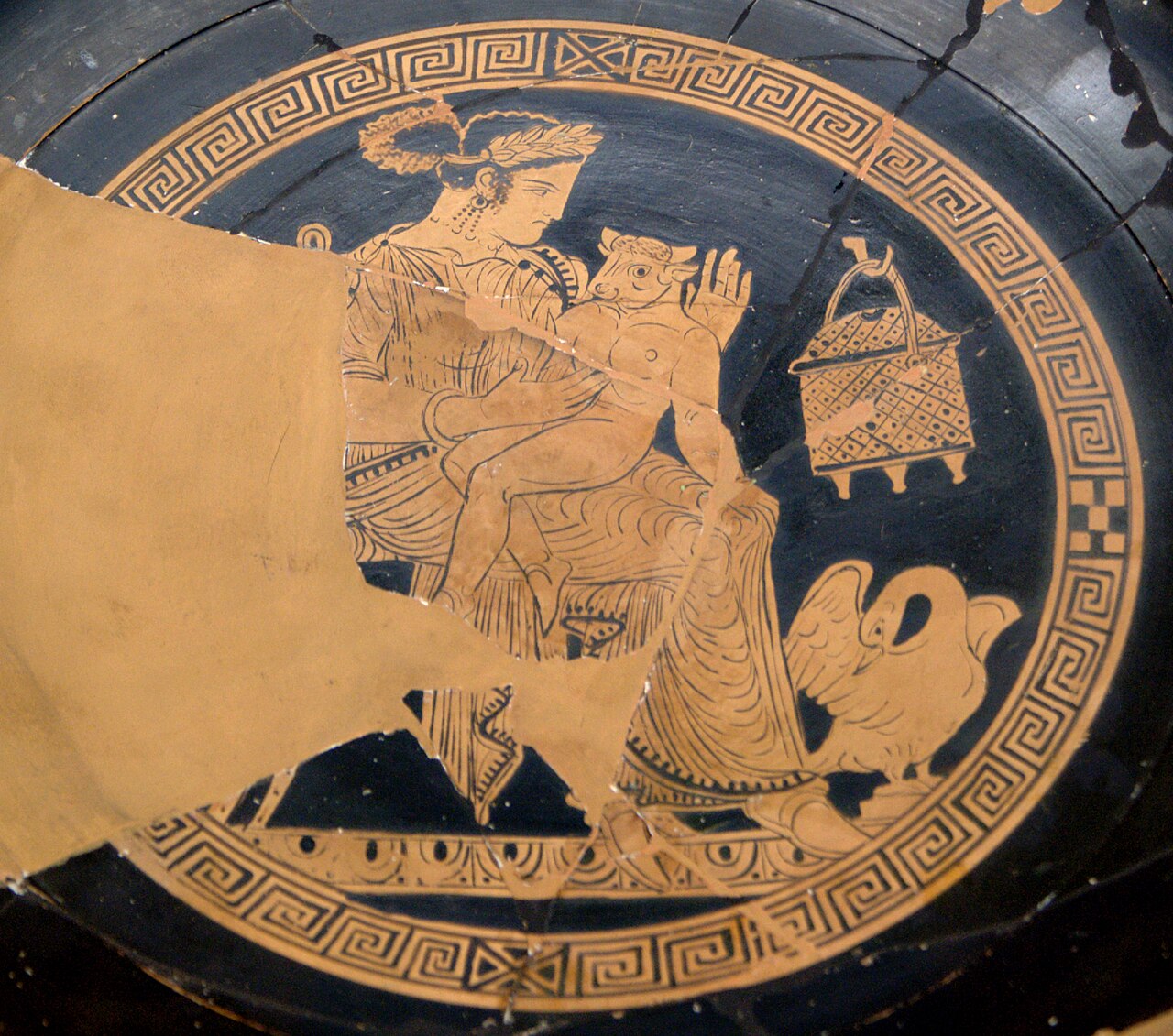
Pasiphae holding the young Minotaur. Attic red-figure kylix attributed to the Settecamini Painter (340–320 BCE), Bibliothèque nationale de France. Photograph by Bibi Saint-Pol, via Wikimedia Commons. Public domain. No changes made.

Pasiphae and the Minotaur: The Queen Behind the Myth
Most retellings reduce Pasiphae and the Minotaur to one uncomfortable scene. However, her own story is much older and more powerful. Pasiphae was a daughter of Helios, the sun. Meanwhile, her sister was Circe, the enchantress of the Odyssey. Fittingly, her name means «she who shines for all.»
Ancient writers treated her as a woman with real power. Apollodorus says she placed a spell on Minos to stop his many affairs. Pausanias describes a sanctuary in Laconia where Pasiphae gave oracles. He also notes that some people there connected her with the moon. Several modern scholars read her as an old Cretan goddess of light. Over time, Greek storytellers turned her into a mortal queen.
Seen this way, the union with the bull looks different. For instance, it may echo a sacred marriage between a goddess and the bull. In fact, that pairing appears again and again in Cretan myth. Europa and the bull of Zeus is the first. Likewise, Pasiphae and the bull of Poseidon form the second. The pattern suggests a memory of ritual, later retold as scandal. For a wider look at how these figures fit Crete’s sacred feminine past, see our guide to Divine Feminine goddess traditions.
Ariadne and the Minotaur: Mistress of the Labyrinth
In the classic version, Ariadne and the Minotaur meet only through a thread. She is the princess who helps the hero and pays for it. However, older evidence gives her a far larger role.
A clay tablet from Knossos, written in Linear B, records a jar of honey offered to da-pu-ri-to-jo po-ti-ni-ja. Most scholars translate this as «the Mistress of the Labyrinth.» Furthermore, many link this title to Ariadne. Her name likely means «most holy» in an early Cretan dialect. Meanwhile, Homer adds another clue. In the Iliad, he describes a dancing floor that Daedalus built at Knossos for Ariadne. In this reading, a dance that winds inward and back out again is a labyrinth in motion.
Taken together, these sources point to Ariadne as a goddess who ruled the Labyrinth long before she gave away its secret. We tell the full story of Ariadne in a dedicated article.
Other Versions of the Minotaur Myth
The Greeks never agreed on one version of the myth. In particular, two ancient writers offered explanations that turned the monster into something else entirely.
Lucian and the Bull in the Sky
Lucian, writing in the second century CE, read the story as astronomy. In his essay on astrology, he says Daedalus taught Pasiphae about the constellation of the Bull. In his interpretation, her «desire for the bull» was really her study of the heavens. Moreover, this reading fits neatly with Asterion’s name and with Pasiphae’s descent from the sun.
Plutarch and the General Named Taurus
Plutarch, in his Life of Theseus, collected a more down-to-earth version from Cretan sources. In this account, the Labyrinth was a prison. Instead, the Athenian youths became prizes in athletic games held in memory of Androgeus. The «bull» was Taurus, a harsh general of Minos, who won those games every time. Ultimately, Theseus defeated him in a wrestling match, and Minos ended the tribute. Significantly, Plutarch also notes that Athenian storytellers shaped the tale in their own favor. Athens was the city that won the last word, so Crete became the villain.
The Bull Mask Theory
Alternatively, another idea starts with ritual. In many ancient cultures, priests or young men wore bull masks during rites of passage. A vase fragment from Thebes shows a man wearing a bull mask in a ritual scene. Now imagine similar rites on Crete. A masked figure in a dark sanctuary could easily become a bull-headed man in the retelling. In such a rite, facing that figure marked the step into adulthood. Scholars still debate this theory, but it explains the Minotaur’s shape better than most.
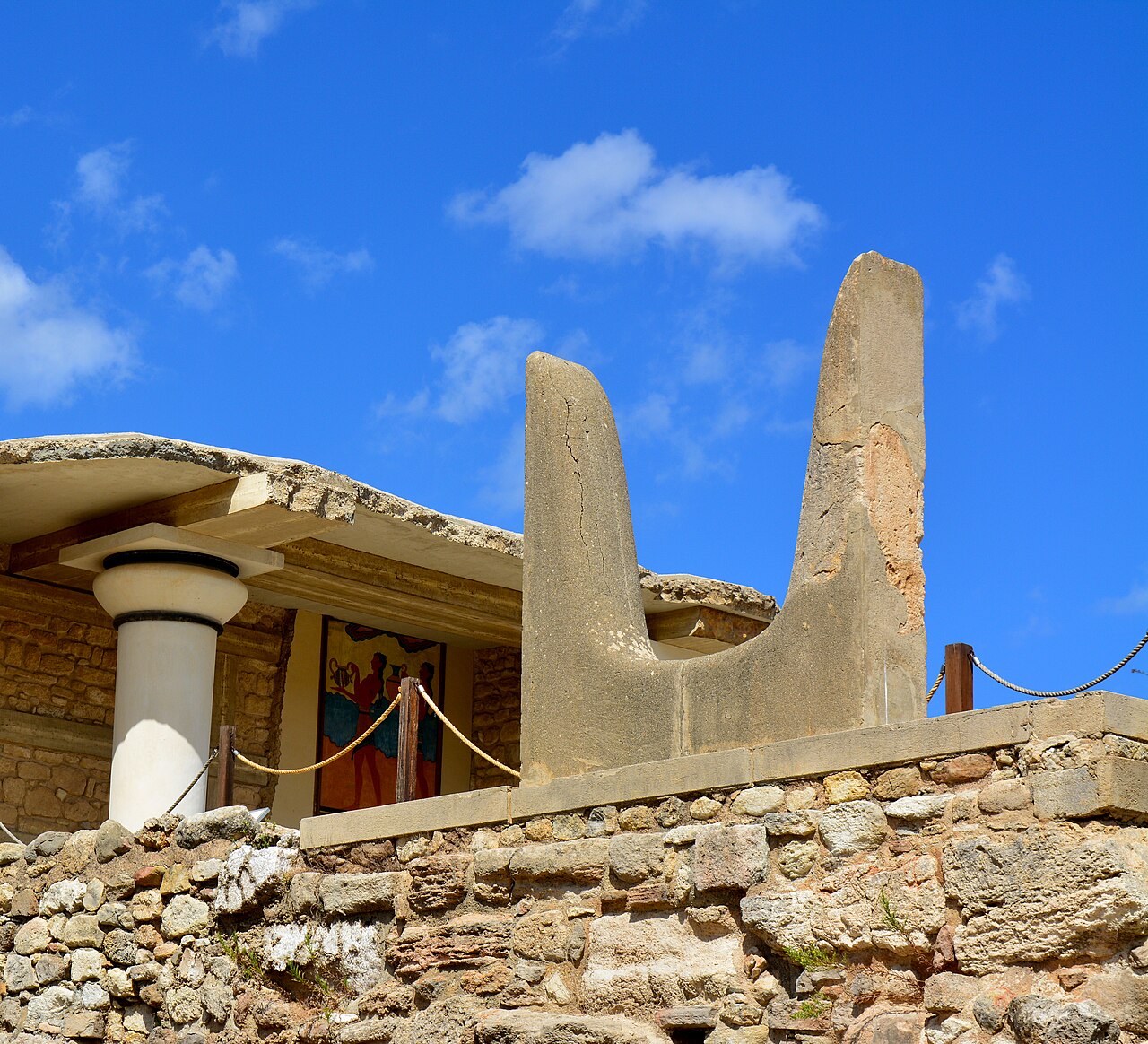
Horns of Consecration at the Palace of Knossos, Crete. Photograph by Afrathianakis Emmanouil (AfraEmm), via Wikimedia Commons. Licensed under CC BY-SA 4.0. No changes made.

Where Is the Labyrinth in Crete?
Tradition places the Labyrinth at the Palace of Knossos, about 5 kilometers south of Heraklion. Ancient Knossian coins carried a labyrinth design, and the archaeologist Arthur Evans identified the palace’s maze of rooms with the myth. However, two other places also carry the name. One is the Labyrinth Cave, a network of old quarry tunnels near Gortyn. The other is a circular Minoan structure found on Papoura Hill near Kastelli in 2024. So far, no single building has been proven to be the mythical Labyrinth.
The Palace of Knossos
The Minotaur labyrinth Knossos link is the oldest and strongest. By the classical period, Knossos minted coins stamped with a labyrinth pattern. In some examples, the Minotaur appears on the other side. Later, Arthur Evans began excavating the site in 1900. His excavations uncovered a palace of over a thousand linked rooms on several levels. Corridors turn, stairways double back, and light wells open unexpectedly. Walking through Knossos Palace, you can easily see how later Greeks, visiting the ruins, decided this was the maze.
The Labyrinth Cave Near Gortyn
Near the ancient city of Gortyn, in south-central Crete, a network of underground tunnels has carried the name «Labyrinth» for centuries. Venetian rulers showed it to important guests as the real thing, and travelers wrote about it from the 1400s onward. Researchers now see it as an ancient stone quarry. Today, however, it does not function as a visitor site. It belongs to the long tradition of storied Crete’s caves. Meanwhile, Gortyn itself ranks among the major archaeological sites in Crete.
The Circular Structure on Papoura Hill
In 2024, workers preparing radar facilities for the new Heraklion airport at Kastelli uncovered a large circular structure on Papoura Hill. It measures about 48 meters across and is made of stone rings with linked inner spaces. Archaeologists date its main use to roughly 2000 to 1700 BCE. Archaeologists think it served communal rituals and feasts rather than daily life. Soon afterward, the press called it a «labyrinth.» For now, excavation continues, and the site is not open to the public. Nevertheless, it shows how central circular, winding spaces were to Minoan ritual.
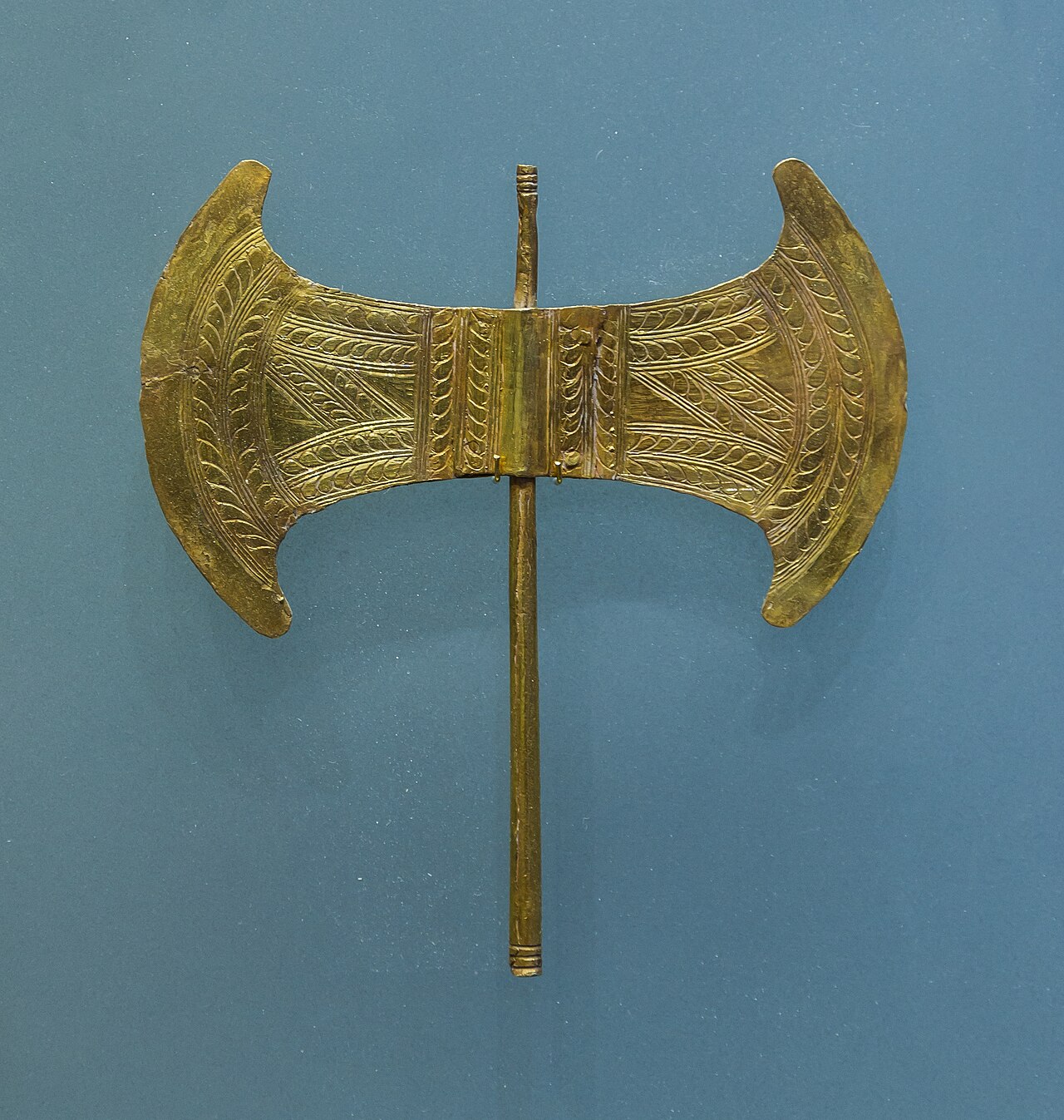
Minoan golden double axe (labrys), a votive offering from Arkalochori Cave (1700–1450 BCE), Heraklion Archaeological Museum, Crete. Photograph by Jebulon, via Wikimedia Commons. Released under CC0 1.0 (Public Domain Dedication). No changes made.

The Labrys: Double Axe Meaning and the Word «Labyrinth»
The labrys is the Minoan double axe, a blade with two symmetrical edges on a single shaft. It was a sacred symbol, not a weapon. For example, the most widely cited theory links it directly to the Labyrinth. Plutarch noted that labrys was a Lydian word for axe. Later, Arthur Evans built on this. Specifically, he proposed that «labyrinth» meant «the house of the double axe.» The ending -inthos marks a place in pre-Greek words, as in Corinth.
The labrys double axe meaning becomes clearer when you look at where the Minoans placed it:
- On walls and pillars: Double axe signs are carved into stone blocks at Knossos, and one area of the palace is still called the Hall of the Double Axes.
- In sacred caves: Worshippers left double axes as offerings in caves such as Arkalochori. Many are thin gold and could never have cut anything.
- At altars: On the painted Hagia Triada sarcophagus, double axes stand on tall poles topped by birds. Women carry out the ritual beside them.
- In women’s hands: In Minoan art, the labrys appears most often in scenes led by priestesses or goddess figures.
Meanwhile, some scholars, most notably Marija Gimbutas, read its shape as a butterfly, a symbol of transformation and renewal. By contrast, others see the two blades as the waxing and waning moon. However, not every linguist accepts the link between labrys and labyrinth. Even so, the link points to something striking. The Labyrinth may first have been a sacred house of the goddess, not a prison for a beast.
The Minoan Bull Cult: Religion Before Monster
For the Minoans, the bull was sacred, not frightening. The Minoan bull cult appears across the island in art, architecture, and ritual objects. Together, these practices form the real background to the Minotaur.
Bull-leaping is the most famous example. Frescoes and small sculptures show young men and women grasping a charging bull’s horns and vaulting over its back. It was therefore likely a ritual performance with religious meaning, not a sport for entertainment.
Horns of consecration, stone shapes that copy a pair of bull’s horns, crowned shrines and palace roofs. In other words, they marked a space as holy.
Bull sacrifice was part of worship. The Hagia Triada sarcophagus shows a bull bound on an offering table while music plays. Ritual vessels shaped like bulls’ heads were used to pour libations.
The bull also stood close to the goddess. In Minoan religion, a female deity held the central place. In this setting, the bull may have served as her partner or her offering. Indeed, this is the same pairing we see in Europa and in Pasiphae. Our articles on the Minoan women and the Minoan sacred year explore that ritual world in more depth. When the Mycenaean Greeks took control of Knossos, they inherited these images without the full meaning behind them. Eventually, a sacred bull ritual became a story about a monster.
Was the Minotaur Real?
No, the Minotaur was not a real creature. No skeleton, burial, or text has ever pointed to a half-human, half-bull being. However, the myth grew from real things that archaeologists can study today.
Three strands most likely came together:
- A palace that felt like a maze. Knossos was large, many-leveled, and confusing. For example, later visitors walking among its ruins could easily picture a labyrinth there.
- A religion centered on the bull. Bull-leaping, bull sacrifice, horned altars, and possibly bull-masked rites gave the island a strong link to the animal.
- A political memory. Minoan Crete once held power across the Aegean. In turn, early Athenians may have remembered paying tribute to Crete, and later told the story with themselves as the heroes.
The Mycenaean Greeks, who later ruled Knossos, carried the images forward and changed their meaning. Our guide to Minoan and Mycenaean civilizations explains how the two cultures met. Ultimately, separating myth from archaeology does not weaken either. Instead, the story keeps its power, and the evidence gives it roots.
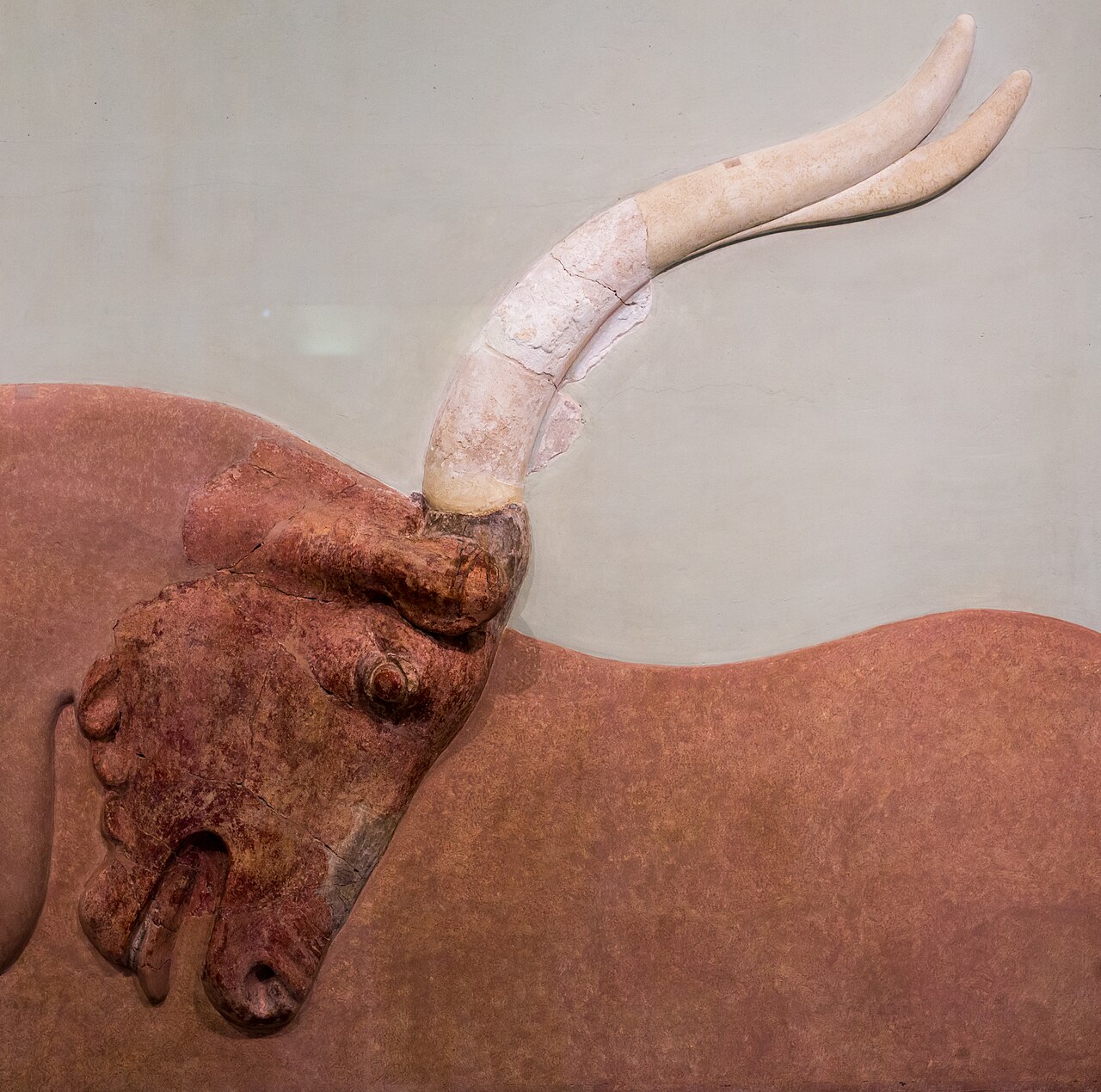
Minoan wall painting depicting bulls among olive trees, from the North Entrance of the Palace of Knossos, Crete. Heraklion Archaeological Museum. Photograph by ArchaiOptix, via Wikimedia Commons. Licensed under CC BY-SA 4.0. No changes made.

Where to See the Minotaur Myth in Crete Today
You cannot visit the Minotaur’s lair, but you can stand where his story took shape. In particular, two places hold almost everything.
At the Palace of Knossos
Look for the details that shaped the legend at Knossos:
- The north entrance bull relief: A reconstructed charging bull in painted plaster greets visitors at the north entrance. The original fragments are in the Heraklion Museum.
- The horns of consecration: A large reconstructed pair stands on the south side of the palace. It frames the hills beyond.
- The Hall of the Double Axes: Part of the residential quarter, named for the labrys signs carved into its stone.
- The corridors and stairways: The Grand Staircase and the narrow passages show why later visitors saw a maze.
- The Theatral Area: A set of wide stone steps near the northwest corner. Some link it to the ritual dances remembered in Ariadne’s myth.
At the Heraklion Archaeological Museum
The Heraklion Archaeological Museum holds the objects that bring the Minoan bull cult into focus:
- The bull’s head rhyton: A black stone vessel with rock crystal eyes and gilded horns, found in the Little Palace at Knossos.
- The bull-leaping fresco: Three figures and a charging bull, one of the most reproduced images from Minoan Crete.
- The ivory bull-leaper: A small, finely carved acrobat caught in mid-leap.
- Gold double axes from Arkalochori: Delicate votive axes made as offerings, not tools.
- The Hagia Triada sarcophagus: Painted scenes of double axes, birds, bull sacrifice, and women leading the rites.
- The Snake Goddess figurines: Clear evidence of the female figures at the heart of Minoan religion.
For a broader view of the island’s artistic world, see our guides to Minoan art and the Snake Goddess figurines.
Tips for a More Meaningful Visit
- Visit the museum and the palace on the same day. That way, seeing the original objects first makes the ruins easier to read.
- Go early or late. For instance, morning light and fewer groups make Knossos quieter and easier to take in.
- Consider the season. Late autumn brings mild weather and calmer sites. Our guide to Crete in October covers what to expect.
- Walk with someone who knows the myths. Above all, a good guide links each fresco to a story and each symbol to a ritual. The ruin starts to feel lived in.
Conclusion
The Minotaur of Crete began as a story Greeks told about a stronger, older island. Yet behind the monster stand real beliefs. Pasiphae may once have been a goddess of light. Ariadne may have held the title Mistress of the Labyrinth. Likewise, the double axe was sacred, and the bull was honored in ritual long before anyone feared it. In this interpretation, the Labyrinth itself may have been a house of the goddess before it became a prison.
Walk through Knossos, then stand before the bull’s head rhyton in Heraklion. There, the myth and the archaeology begin to speak to each other. Ultimately, neither cancels the other out. Elissos creates private days at Knossos and Crete’s sacred sites for travelers who want to follow that conversation in person. Our guides know both the stories and the stones.
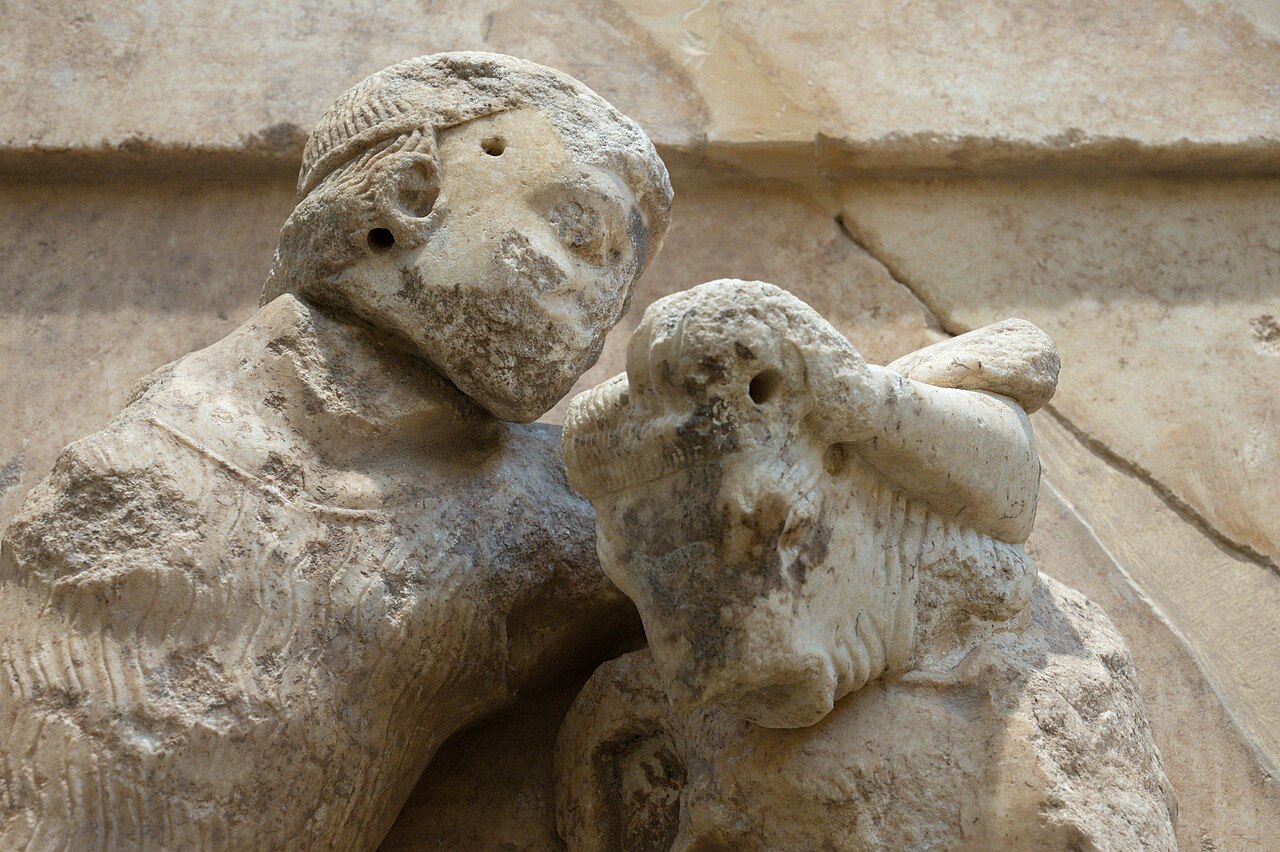
Ancient Greek relief depicting Theseus fighting the Minotaur, from the Treasury of the Athenians at Delphi (c. 500 BCE), Archaeological Museum of Delphi. Photograph by Zde, via Wikimedia Commons. Licensed under CC BY-SA 4.0. No changes made.

Frequently Asked Questions
What is the Minotaur of Crete?
The Minotaur is a creature from Greek mythology with a man’s body and a bull’s head. In the myth, Queen Pasiphae of Crete bore him after Poseidon cursed her with desire for a sacred white bull. King Minos kept him inside the Labyrinth at Knossos until Theseus killed him.
Where is the labyrinth in Crete?
Tradition places the Labyrinth at the Palace of Knossos, near Heraklion. Ancient coins from Knossos carried a labyrinth design. However, two other sites carry the name. One is the Labyrinth Cave, an old quarry near Gortyn. The other is a circular Minoan structure on Papoura Hill near Kastelli, found in 2024.
Was the Minotaur real?
No. No evidence of a half-human, half-bull creature has ever been found. Instead, the myth likely grew from the complex layout of Knossos, the Minoan bull cult, and an Athenian memory of paying tribute to Crete.
Can you visit the Minotaur’s labyrinth?
You can visit the Palace of Knossos, the site most closely linked to the Labyrinth. It is open to visitors year-round. The Labyrinth Cave near Gortyn and the Papoura Hill structure are not set up as visitor sites.
Who were Pasiphae and Ariadne?
Pasiphae was the queen of Crete, a daughter of the sun god Helios, and the mother of the Minotaur. Ariadne was her daughter with King Minos. She gave Theseus the thread that led him out of the Labyrinth. Linear B evidence suggests both may have roots in older Cretan goddess figures.
What does the labrys double axe mean?
The labrys is the Minoan double axe, a sacred symbol used in ritual rather than battle. It appears at altars, in caves, and in scenes led by women. Many scholars link the word «labyrinth» to «labrys.» It may mean «house of the double axe.»
What was the Minoan bull cult?
The Minoan bull cult was a set of religious practices honoring the bull. It included bull-leaping, bull sacrifice, bull-shaped ritual vessels, and the horns of consecration placed on shrines. In turn, the cult likely shaped the later Greek myth of the Minotaur.
Featured image by: Stuart Wolfe (Stw-kunst), via Wikimedia Commons. Licensed under CC BY-SA 4.0. No changes were made to the original image.
