
Phaistos Palace, Crete: The Minoan Site Worth the Drive South
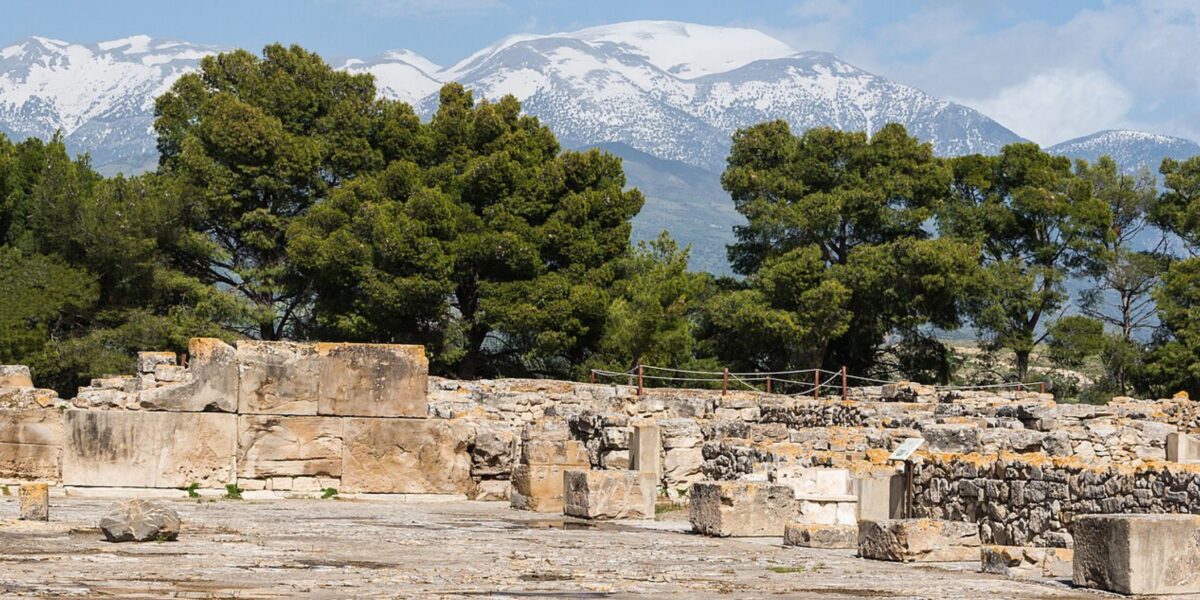
Phaistos Palace is the second-largest Minoan palace in Crete, situated on a hilltop in the Mesara plain about 55 kilometers south of Heraklion.
Built around 2000 BC and rebuilt after earthquake destruction around 1700 BC. It served as the political and religious center of southern Crete for roughly 450 years. The site covers approximately 8,500 square meters of excavated ruins. It is known for its sweeping views of Mount Ida, the Asterousia range, and the Libyan Sea. Phaistos gained UNESCO World Heritage recognition in July 2025 as part of the Minoan Palatial Centres inscription. It is home to the famous Phaistos Disc, a clay artifact stamped with 241 undeciphered symbols, and contains one of the best-preserved lustral basins on the island. Entrance costs 15 euros per adult, with a reduced fee of 8 euros.
If you have already been to Knossos, or if you are deciding between the two, this guide will give you everything you need to make the most of a visit to Phaistos.
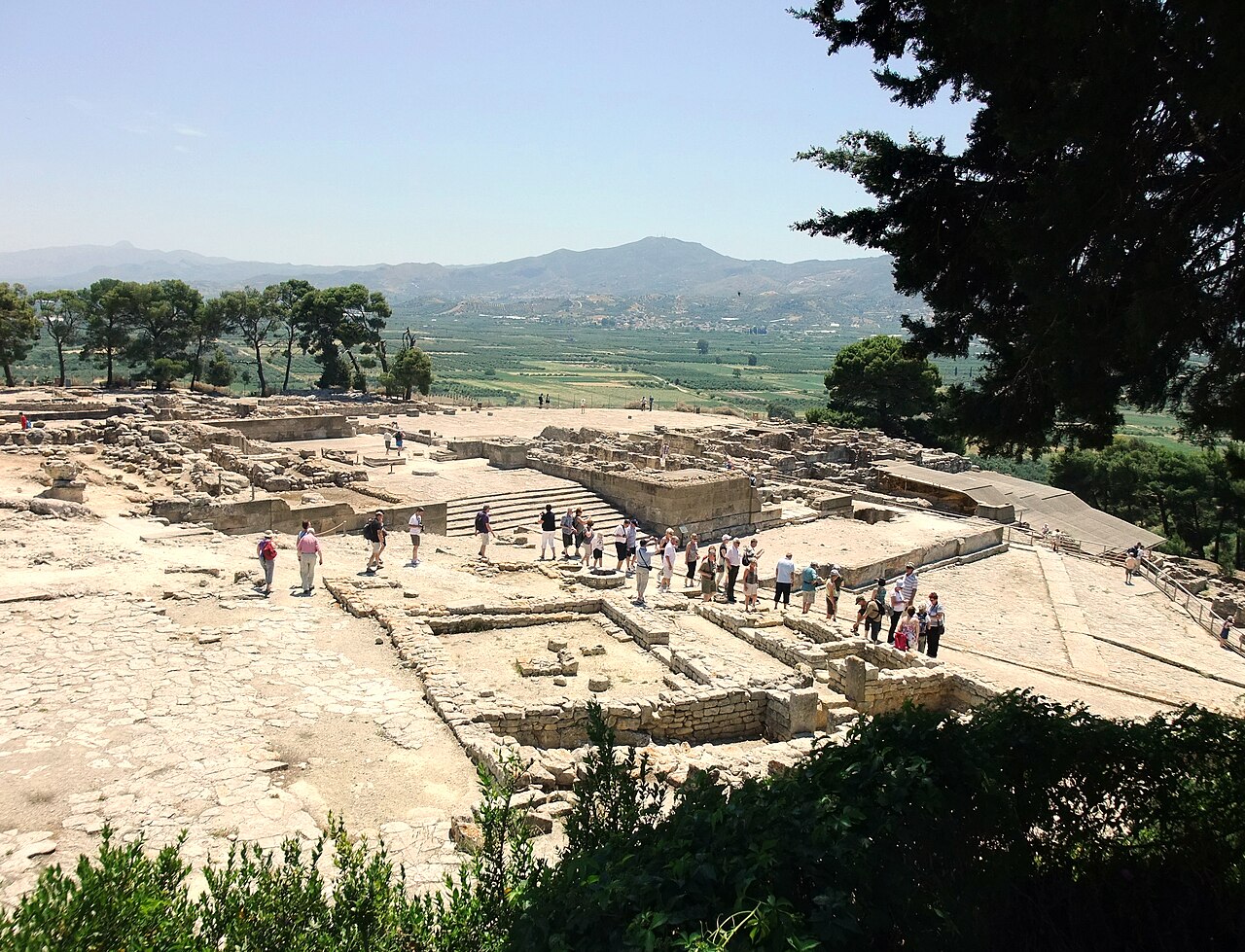
Minoan palace, archaeological site Phaistos, Crete, Greece by Nikater, via Wikimedia Commons, licensed under CC BY-SA 3.0. Image used without edits or changes.
What Is Phaistos Palace in Crete?
Phaistos Palace is the second-largest Minoan palace in Crete. Located on a hilltop in the Mesara plain, approximately 55 kilometers south of Heraklion. Built around 2000 BC and rebuilt after seismic destruction around 1700 BC, it served as the political and religious center of southern Crete for roughly 450 years. The site covers approximately 8,500 square meters and is known for its panoramic views of Mount Ida, the Asterousia range, and the Libyan Sea. Phaistos was inscribed on the UNESCO World Heritage List in July 2025 as part of the Minoan Palatial Centres. It holds the Phaistos Disc discovery site and one of the best-preserved lustral basins on the island. Standard entrance is 15 euros; reduced entry is 8 euros.
A City That Began Before the Palaces Did
The site at Phaistos has been occupied since around 6000 BC, making it one of the oldest continuously inhabited locations in Crete. Long before the first palace walls went up, communities were living and farming in the Mesara plain below. One of the most fertile stretches of land on the island.
By around 3000 BC, the area entered the Early Minoan period, and settlement on the hill began to take on more organized form. It was not until the Middle Minoan period, roughly 2000 BC, that the first proper palace was constructed. Ancient sources mention the city in connection with King Minos, the legendary ruler of Crete, and name his brother Rhadamanthys as the first king of Phaistos, a figure associated in mythology with justice and the underworld. Homer counted Phaistos among the cities of Crete that sent warriors to Troy. Strabo later placed it on the map as a significant urban center.
In the Archaic period, after the Minoan era had long passed, a temple to Rhea, the Great Mother goddess, was built directly on the southern remains of the old palace. That choice of location was not accidental. Sacred ground tends to stay sacred across different eras. The site continued to be inhabited in various forms until the first century BC, when it was finally absorbed by the neighboring city of Gortyna.
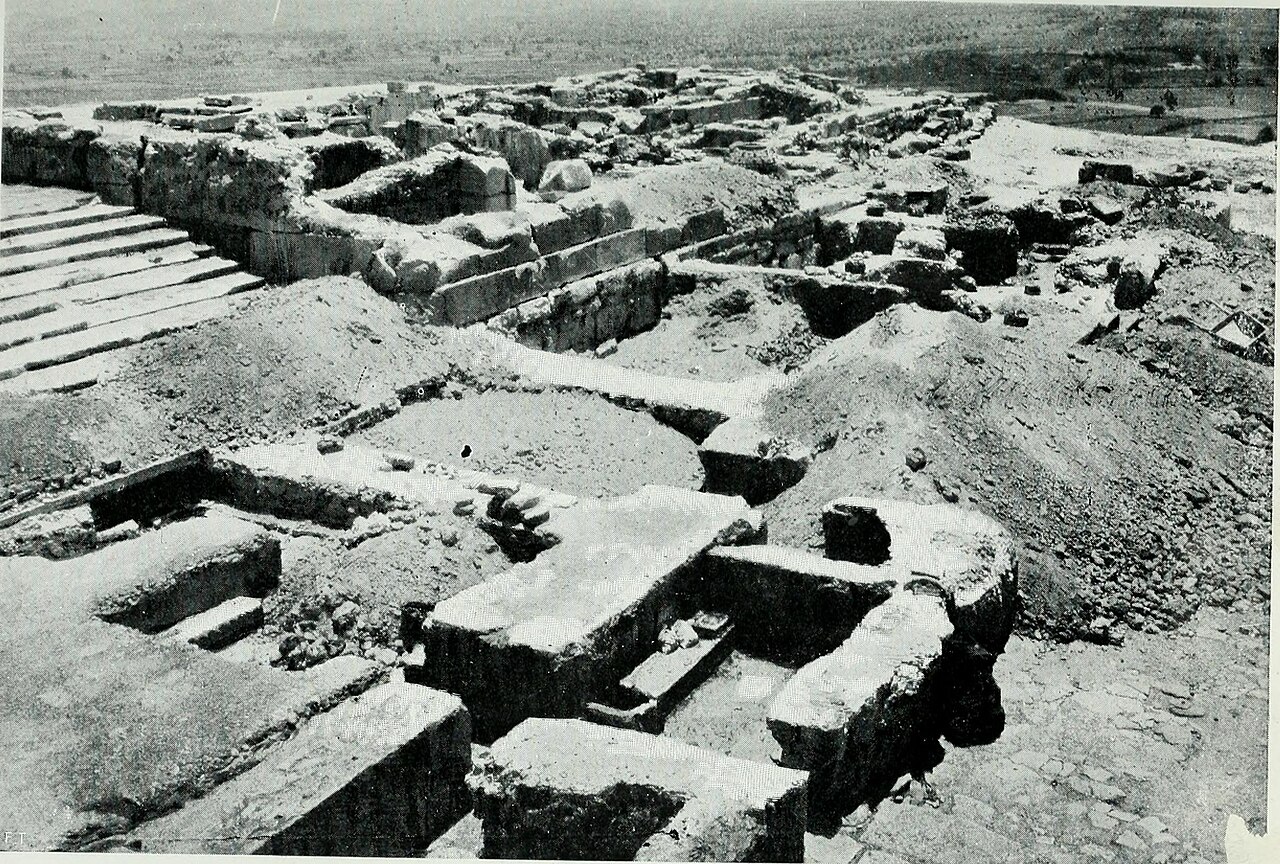
Illustration from The Palaces of Crete and Their Builders (1907), via Wikimedia Commons and Internet Archive Book Images, marked as no known copyright restrictions. Image used without edits or changes.
The Two Palaces: What Was Built, What Survived
The Old Palace (circa 2000 to 1700 BC)
The first palace at Phaistos was built during the Middle Minoan I period, around 2000 BC. Italian archaeologist Federico Halbherr began excavations here in 1884. Work continued under Luigi Pernier from 1900 to 1904, then resumed under Doro Levi from 1950 to 1971. What they uncovered was a complex structure with paved courtyards, storage areas, and architectural features typical of early Minoan design, including multiple gateways, well-maintained facades, and what appear to be performance or assembly spaces.
The Old Palace was destroyed twice by seismic events and rebuilt. When the final destruction came around 1700 BC, the builders of the new palace did something unusual. Rather than clearing the old ruins completely, they covered much of the Old Palace to create leveled ground for the new construction. This means that portions of both palace phases are visible at the site today, something that is relatively rare across Minoan Crete.
The New Palace (circa 1700 to 1450 BC)
The New Palace was built after the widespread destruction event of around 1700 BC that affected Minoan sites across the island. It was a larger, more sophisticated structure, with a grand staircase, a central courtyard, royal apartments, storage magazines, workshops, and carefully designed sacred spaces.
This second palace was destroyed around 1450 BC, along with most other Minoan palatial centers on the island, in events that archaeologists continue to debate. Some point to the volcanic eruption at Santorini; others argue for internal conflict or a combination of causes. What is clear is that the New Palace was not substantially rebuilt afterward, which is part of why the ruins have a more complete, less disturbed quality than sites that saw later occupation and modification.
Sacred Spaces at Phaistos: The Temple of Rhea and the Lustral Basins
One of the most meaningful aspects of Phaistos for anyone interested in Minoan religious life, or in the thread of divine feminine symbolism that runs through Cretan prehistory, is the presence of sacred ritual spaces that survived into later periods.
In the Archaic period, a temple dedicated to Rhea, the Great Mother, was constructed on the southern part of the old palace remains. Rhea was one of the most ancient goddess figures in the Greek pantheon. A pre-Olympian deity associated with the earth, with fertility, with the protection of the young, and with the primordial forces of nature. The fact that her temple was built on top of Minoan ruins connects the much older Minoan goddess traditions to the later Greek religious world. The site held a memory that later cultures continued to honor.
The palace also has four lustral basins, more than any other Minoan site. A descending L-shaped staircase leads into a lustral basin, a sunken chamber left open at the top so people could observe those inside from above. Archaeologists believe people used these spaces for ritual purification, perhaps before they entered the most sacred parts of the palace. The lustral basin beside the King’s Megaron remains the best-preserved example in all of Crete. Whether the rituals here involved the goddess, water, or both, these spaces show that the palace builders wove sacred preparation into the physical fabric of the palace itself.
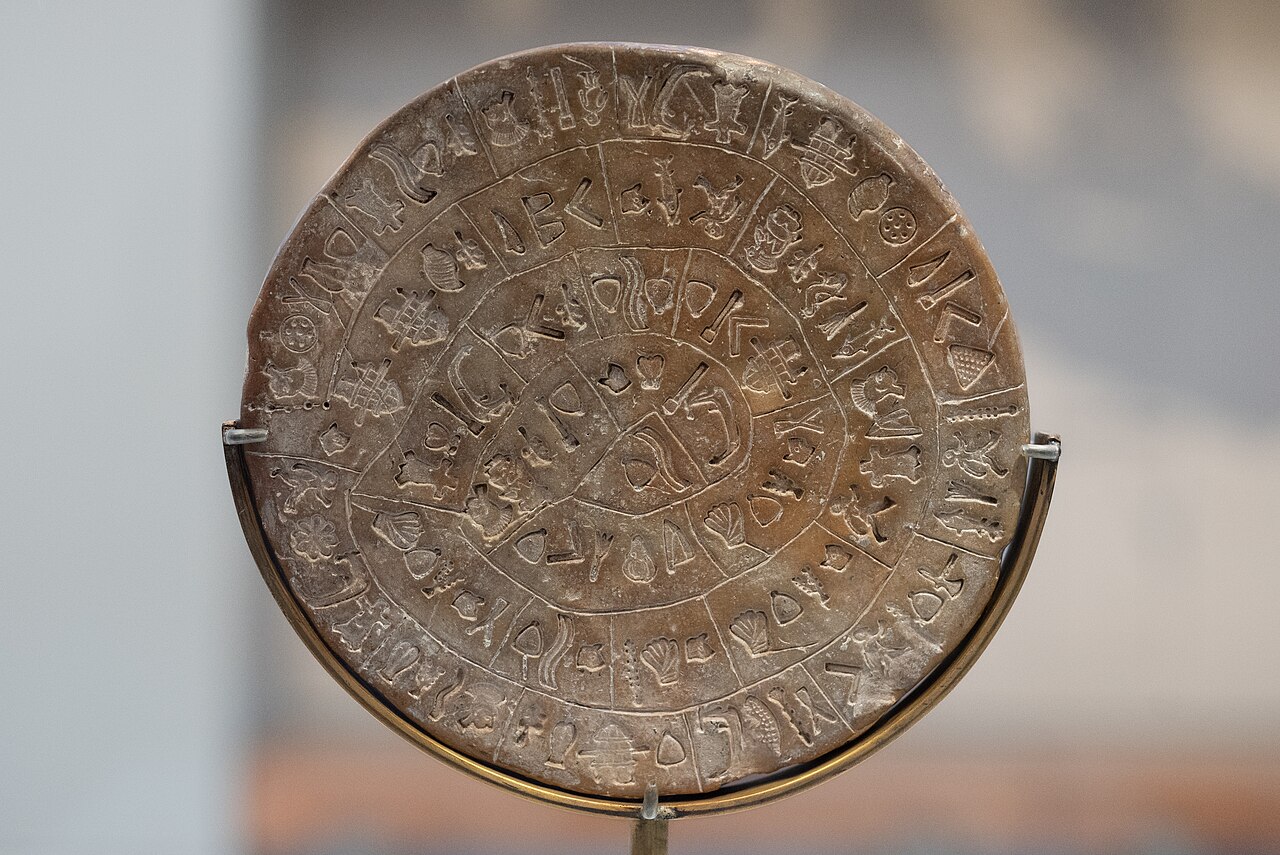
Phaistos Disc — Side B by Gleb Simonov, via Wikimedia Commons, dedicated to the public domain under CC0 1.0 Universal Public Domain Dedication. Image used without edits or changes.
The Phaistos Disc: What We Know (and What We Do Not)
On July 3, 1908, Italian archaeologist Luigi Pernier discovered a fired clay disc in a small underground room in the northeast section of the palace, a space that excavators called the Archive. The disc was found in what appears to have been a temple depository, sealed beneath a layer of fine black ash and plaster, alongside a tablet inscribed with Linear A script.
The disc itself is approximately 15 centimeters in diameter. Both sides are covered in a spiral sequence of stamped symbols, 241 impressions in total, made from 45 distinct signs. The symbols were applied with small individual stamps, pressed into the wet clay before firing, making this the earliest known example of moveable type in human history. The disc has never been successfully deciphered, and debate continues over whether it represents a writing system, a ceremonial text, a calendar, a religious hymn, or something else entirely.
The original disc is held at the Heraklion Archaeological Museum. Where it is one of the most-visited artifacts in the collection. Replicas are available at the site. If you are visiting Phaistos before heading to Heraklion, plan time at the museum afterward as the disc on display will carry considerably more weight once you have stood in the room where it was found.
Phaistos vs Knossos: Why This Site Deserves Its Own Visit
Knossos is the largest and most famous Minoan palace in Crete, and it is the logical starting point for most people exploring Minoan civilization on the island. But Phaistos offers something different, and for many visitors it ends up being the more affecting experience.
Knossos was extensively reconstructed by British archaeologist Arthur Evans in the early twentieth century. His use of reinforced concrete and painted plaster restorations created a visually dramatic site. But one where it can be difficult to know where ancient material ends and modern interpretation begins. Phaistos was excavated but not reconstructed. The walls you walk beside at Phaistos are the actual Bronze Age stones, exactly as they came out of the earth. That is a fundamentally different kind of encounter.
There is also the question of atmosphere. Knossos sits in a suburban valley just outside Heraklion, surrounded by tour buses and souvenir stands. Phaistos sits on an isolated hill with a 360-degree view of one of the most beautiful plains in Crete. The experience is quieter, more physical, and in some ways more honest about what these ancient spaces actually were.
Both sites became UNESCO World Heritage Sites in July 2025, inscribed together as part of the Minoan Palatial Centres of Crete. The recognition affirms what archaeologists have long understood: these are not just Greek ruins. They are foundational monuments of European civilization.
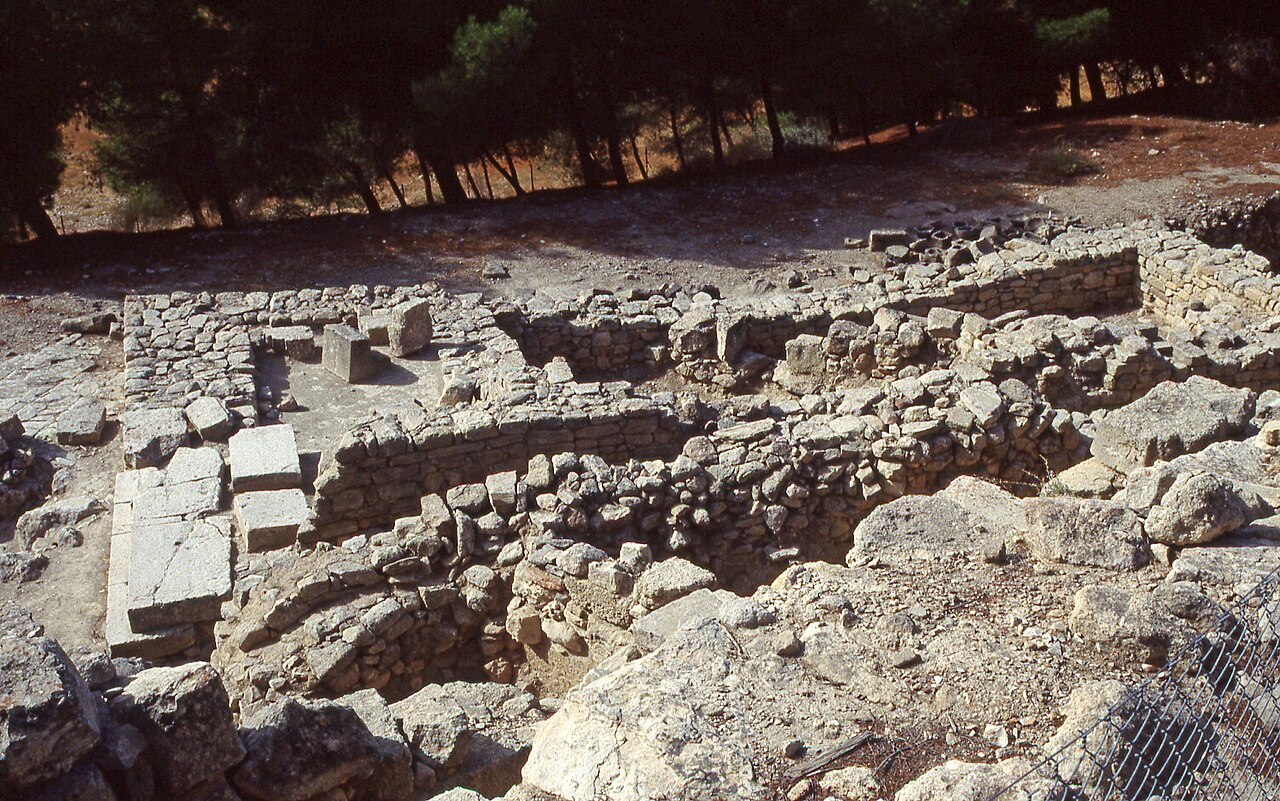
Phaistos “Temple of Rhea” from NE by Mark Landon, via Wikimedia Commons, licensed under CC BY 4.0. Image used without edits or changes.
What to See at Phaistos: A Practical Tour of the Site
The site covers around 8,500 square meters and is walkable in one to two hours at a relaxed pace. There is a logical circuit that moves through the main areas without backtracking. Here is what to look for:
The West Court and Theatral Area
You enter from a paved Northwest Court and descend to the West Court, one of the oldest parts of the site. Here you will find the theatral area, a stepped semicircular space that may have been used for public gatherings, performances, or rituals. The west court also contains the remains of Minoan houses from the Hellenistic period, evidence of the long occupation span of this hilltop.
The Great Staircase and Central Court
The monumental staircase that leads from the west terrace toward the Central Court is one of the most impressive architectural features at Phaistos. It is wide, well-preserved, and gives a strong sense of the scale the Minoans worked at when they wanted to impress. The Central Court, measuring roughly 22 by 46 meters, was the ceremonial heart of the palace, aligned north to south in the Minoan tradition. The south side of the court holds the remains of the Neolithic kiln and the Temple of Rhea.
The Royal Apartments and Lustral Basin
The north wing of the palace held the royal apartments, built with alabaster and other high-quality materials. Architectural features here include light wells, pier-and-door partitions (known as polythyra), and porticos, all characteristic of the more sophisticated rooms in Minoan palaces. Adjacent to the King’s Megaron is the best-preserved lustral basin on the island, a sunken ritual space with its descending staircase still largely intact.
The Archive Room and Disc Find Spot
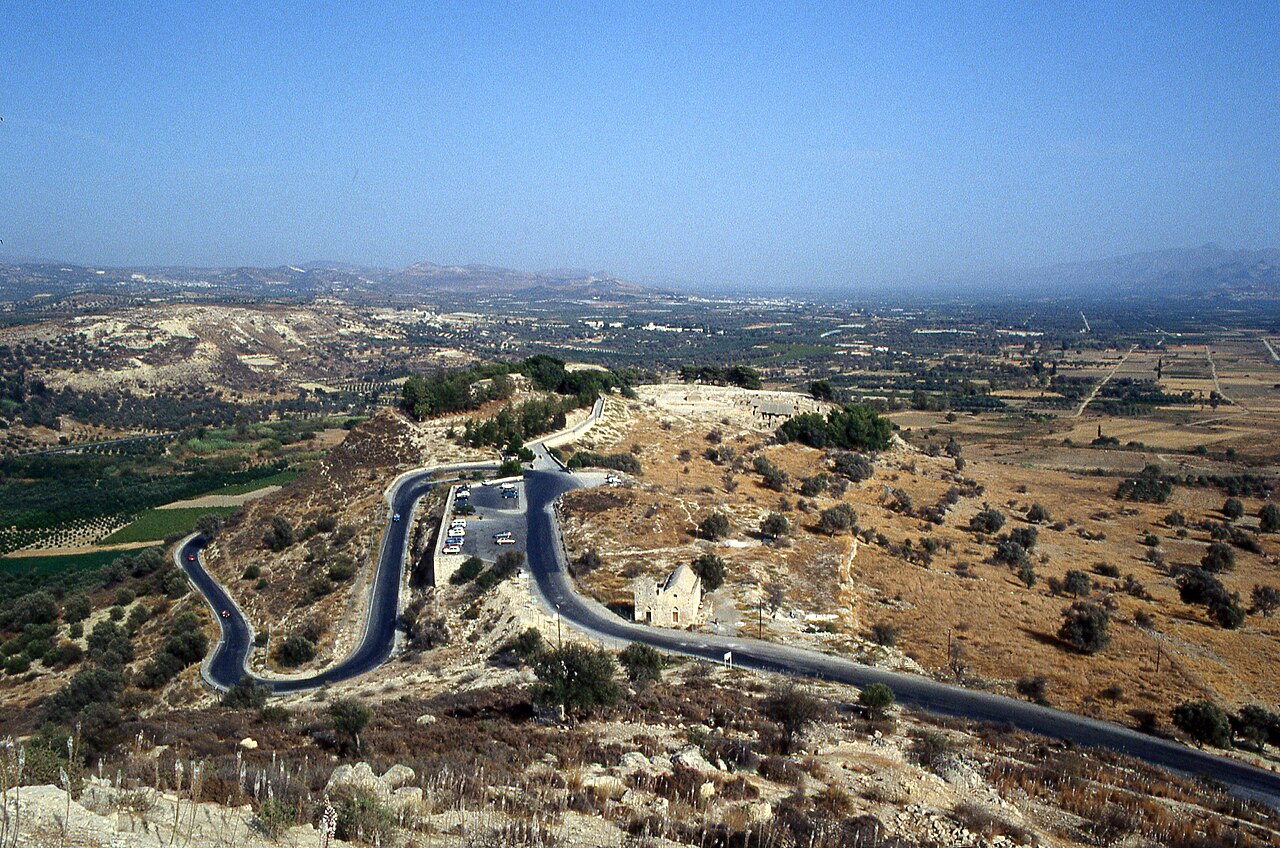
How to Get to Phaistos from Heraklion (and Beyond)
Phaistos is approximately 55 kilometers south of Heraklion, a drive of about one hour under normal traffic conditions. The road crosses inland through the agricultural heartland of Crete. Passing through Agia Varvara and climbing over the plateau before descending into the Mesara plain. The landscape itself is part of the experience.
From Chania, the drive is around 132 kilometers and takes approximately two hours and fifteen minutes. There is no direct bus from Chania to Phaistos. Most visitors from the west of the island either rent a car or join an organized day trip from Heraklion.
Public buses from Heraklion (KTEL) run to Phaistos via Mires. The journey takes around 90 minutes and runs several times daily. Check the current KTEL timetable before you travel, as schedules vary by season.
Parking is available at the site. If you are driving, factor in the return drive and any additional stops you plan to make.
Combining Phaistos with Agia Triada and Matala
The area around Phaistos contains some of the richest archaeology in Crete. With a car you can easily combine the palace with two other stops that together make for a full, genuinely rewarding day.
Agia Triada is a Minoan villa complex located about three kilometers from Phaistos, connected by a path that takes around an hour to walk. The site is smaller and quieter than Phaistos. But it has produced some of the most remarkable Minoan art ever found. Including painted frescoes, the Harvester Vase, and the Boxer Rhyton, all now in the Heraklion museum. The site has a separate entrance fee of five euros. A visit of thirty to forty-five minutes is usually enough.
Matala is a coastal village about eleven kilometers from Phaistos. In antiquity it served as the port of Phaistos. In the 1960s it became known as a gathering point for artists and travelers who lived in the ancient cliff caves above the beach. The caves are Neolithic in origin, carved into soft limestone. The beach itself is attractive and the village has several good tavernas. If you are visiting in summer, aim to reach Matala either in the morning or after 4 pm to avoid the peak heat and crowds.
Gortyna, the ancient city that eventually absorbed Phaistos, is also nearby, about fifteen kilometers to the east. It is notable for the Gortyn Code, the oldest and most complete legal inscription from ancient Greece, carved in stone in the fifth century BC. A visit there adds depth to the sense of how long this part of Crete has been a center of organized civilization.
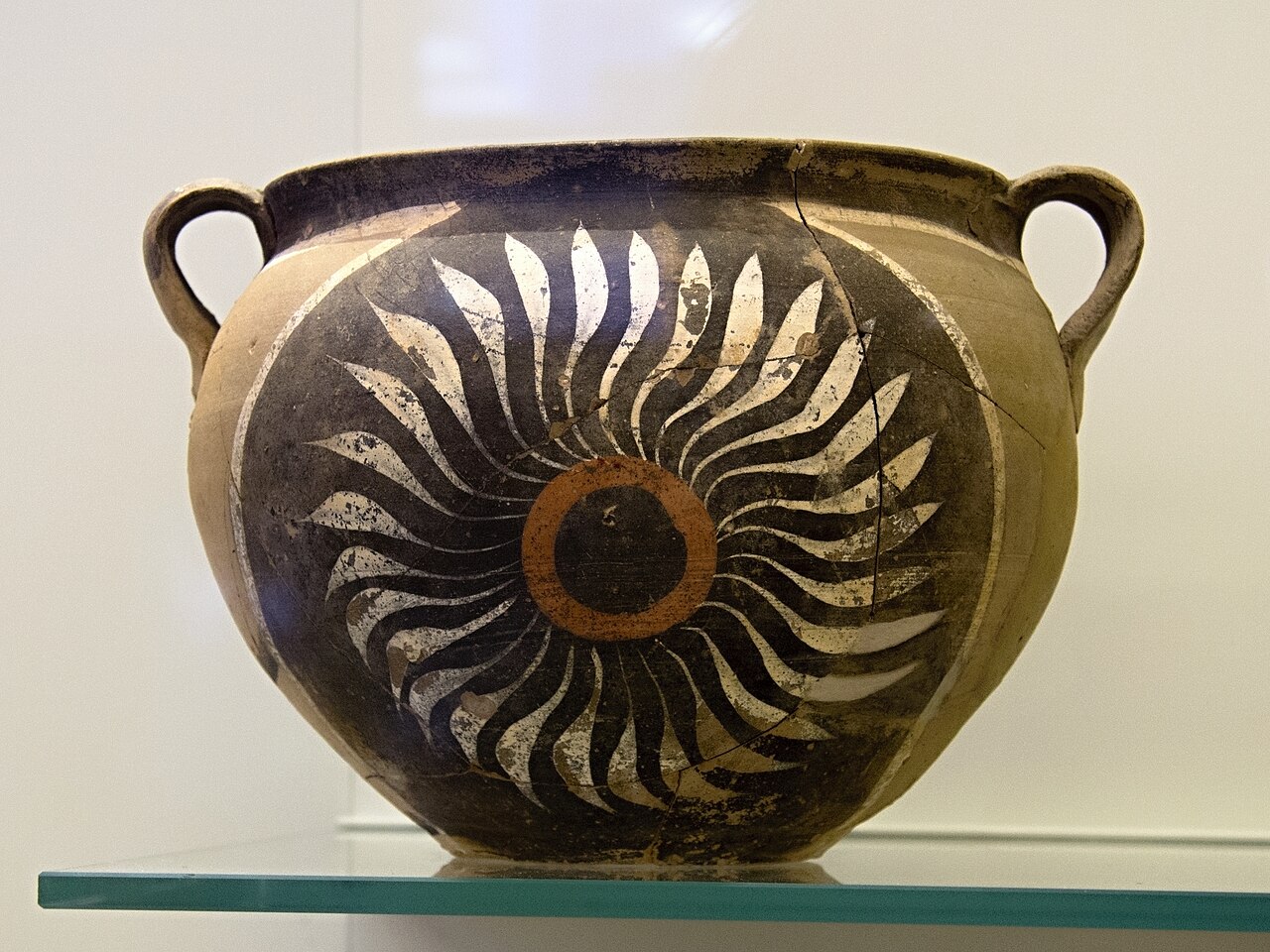
Kamares ware vessel, Phaistos, 1800–1700 BC by Zde, via Wikimedia Commons, licensed under CC BY-SA 4.0. Image used without edits or changes.
Practical Visitor Tips for Phaistos
Entrance fee: Standard admission is 15 euros per adult. Reduced admission (8 euros) is available for EU citizens aged 65 and over, students, and other qualifying categories. There is a combined ticket available with Agia Triada.
Opening hours: The site is open year-round. In summer (April through October) it is typically open from 8 am to 8 pm. In winter hours are shorter. Always confirm current hours before visiting, as these can change.
Best time to visit: May, June, September, and early October offer the best balance of good weather, manageable crowds, and comfortable walking temperatures. July and August are hot; if you visit in summer, arrive at opening time or in the late afternoon. The site has limited shade.
What to bring: Water is essential, especially in summer. There is a small canteen near the entrance, but it is better to come prepared. Wear comfortable shoes with a grip; the stone surfaces can be uneven. A hat and sunscreen are necessary from April onward.
Accessibility: The site involves multiple staircases and uneven terrain. Visitors with limited mobility should be aware that significant portions of the site will be difficult or impossible to access on foot.
Photography: Photography is permitted throughout the site. The light is best in the early morning and late afternoon. Both for photography and for the quality of your visit generally.
Guided tours: There are fewer guides available at Phaistos than at Knossos, and they are worth booking in advance if you want a structured, informed visit. Most organized day trips from Heraklion include Phaistos alongside Gortyna and sometimes Matala.
The Broader Context: Phaistos Within Minoan Crete
To understand what Phaistos meant in its time, it helps to have a working sense of how Minoan civilization developed across Crete as a whole. The island during the palatial period was not a unified political state in the modern sense. It was a network of powerful centers. Each with its own palace, its own regional authority, and its own religious and economic life. Knossos was the largest of these, but Phaistos was its equal in the south.
The Minoan world was also one in which the feminine principle held significant religious weight. Goddess figurines, sacred symbols, and ritual spaces oriented toward female divine power appear consistently across excavated sites. The Minoan snake goddess, one of the most recognizable figures from this civilization, is one expression of this. The lustral basins and the temple of Rhea at Phaistos are another. These are not isolated curiosities. But elements of a consistent religious worldview that placed the sacred feminine at the center of Minoan life.
The artifacts found at Phaistos and across southern Crete are mostly held at the Heraklion Archaeological Museum. It is an essential complement to any site visit. Minoan art and the objects found across these excavations tell a story that the ruins themselves can only suggest.
Conclusion: Why Phaistos Stays With You
Phaistos Palace in Crete is one of those places that rewards the effort of getting there. It is not as immediately legible as a reconstructed site. Also, it requires a bit more from the visitor in terms of imagination and patience. But what it gives back is something more durable: a direct encounter with ancient stones that have not been interpreted for you, set within a landscape of genuine, undiluted beauty.
The Phaistos Disc, the Temple of Rhea, the lustral basins, the theatral area, the royal apartments with their stone floors still intact. These are not props. They are what remain of a civilization that shaped the trajectory of European culture. Walking through the site, particularly on a quiet morning when the light is still low and the Mesara plain spreads out below you, it is not difficult to understand why this hilltop was considered significant for eight thousand years.
UNESCO inscribed Phaistos as a World Heritage Site in 2025. The recognition is overdue and correct. This is not a secondary site to be visited if you have time left over. It is, in its own right, one of the most important and atmospheric archaeological places in Greece.
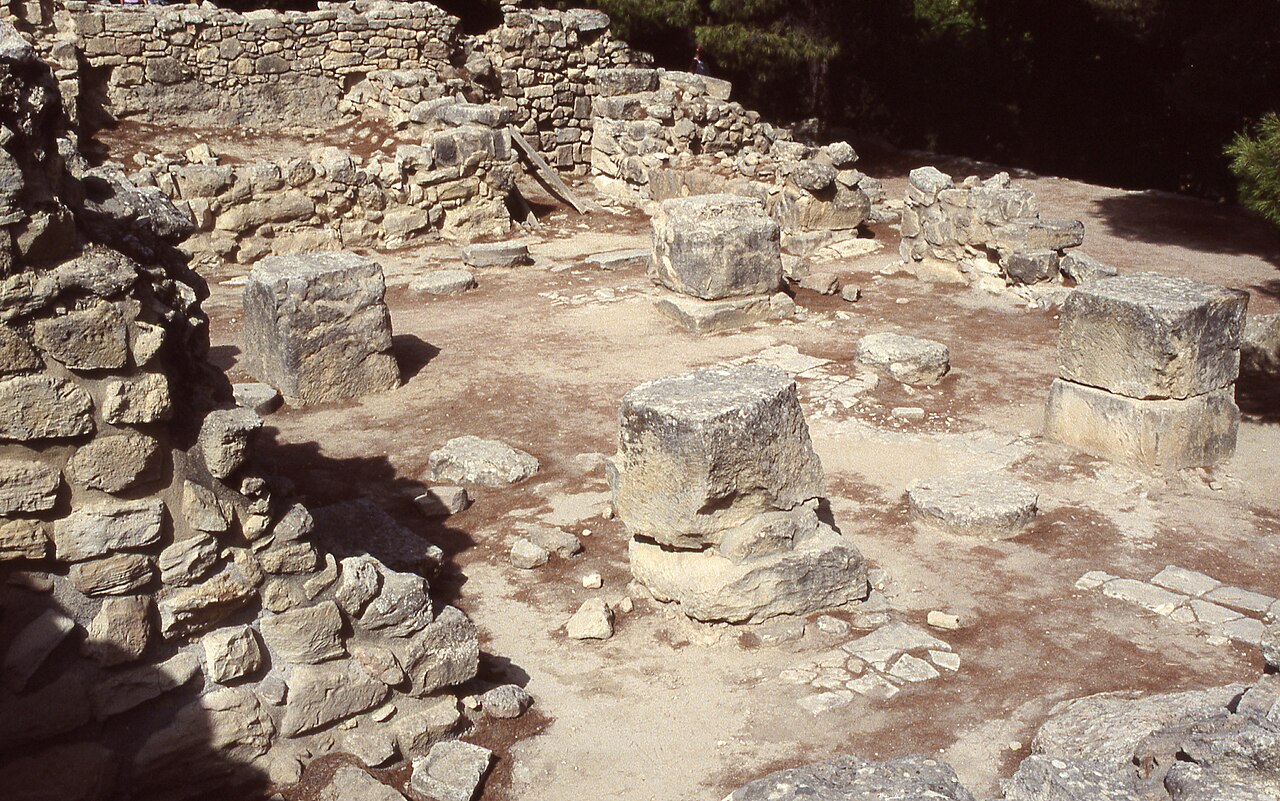
Phaistos Old Palace northeast peristyle hall from SE by Mark Landon, via Wikimedia Commons, licensed under CC BY 4.0.
Frequently Asked Questions About Phaistos Palace
How far is Phaistos from Heraklion?
Phaistos is approximately 55 kilometers south of Heraklion. The drive takes about one hour by car, depending on traffic and road conditions.
What is the Phaistos Disc?
The Phaistos Disc is a fired clay disc approximately 15 centimeters in diameter, discovered at the site in 1908. Both sides feature 241 stamped impressions of 45 distinct symbols arranged in a spiral. Scholars have not deciphered the script, and they still do not know its purpose. The Heraklion Archaeological Museum displays the original.
Is Phaistos worth visiting if you have already been to Knossos?
Yes. Phaistos is an unrestored site. Which means the ruins are authentic Bronze Age material without the concrete additions that characterize Knossos. The setting is also significantly different: an open hilltop with panoramic views rather than a suburban valley. Many visitors find Phaistos more atmospheric and more honest as an archaeological encounter.
How long do you need at Phaistos?
Plan for one to two hours at the site itself. If you are combining it with Agia Triada and Matala, allow a full day.
Is Phaistos a UNESCO World Heritage Site?
Yes. UNESCO inscribed Phaistos on the World Heritage List in July 2025 as part of the Minoan Palatial Centers of Crete. This is a serial inscription that also includes Knossos, Malia, Zakros, Zominthos, and Kydonia.
What is the best time of year to visit Phaistos?
May, June, September, and early October offer the most comfortable visiting conditions. The site is open year-round. In July and August, visit early in the morning or late in the afternoon to avoid peak heat.
Can you combine Phaistos with other sites in one day?
Yes. Agia Triada is three kilometers away and adds about thirty to forty-five minutes. Matala is eleven kilometers away and works well as a lunch stop or afternoon beach break. Gortyna is about fifteen kilometers east and adds another hour.