
Iconic Minoan Artwork and Its Cultural Impact
Long before the Parthenon stood on the Athenian Acropolis, a vibrant and sophisticated civilization flourished on the island of Crete. The Minoans, often cited as Europe’s first great Bronze Age civilization, left behind a visual legacy that remains breathtaking even four thousand years later. Minoan artwork is defined by its pulsating energy, a rich palette of blues, ochres, and reds, and a deep-seated reverence for the natural world. Unlike the rigid, monumental art of their contemporaries in Egypt or Mesopotamia, Minoan art feels remarkably modern, a testament to a society that prioritized fluid movement, grace, and joy.
Defining The Aesthetic Of Minoan Art: A Bronze Age Revolution
To step into the world of Minoan art is to witness a revolution in ancient aesthetics. While neighboring empires used art primarily for monarchical propaganda and the glorification of military conquest, the Minoans took a different path. Their work is characterized by a „naturalistic“ style that celebrates life in its most active forms. You won’t find many depictions of kings crushing enemies here; instead, you find dolphins leaping through waves and lithe figures engaged in ritualistic dance. This lack of heavy-handed political messaging suggests a culture that valued the aesthetic experience as much as the social order.
The Discovery of Minoan Art Work at Knossos
Our modern understanding of this culture began in 1900, when Sir Arthur Evans began excavations at the Palace of Knossos. He didn’t just find buildings; he uncovered a sophisticated world of Minoan art work that completely upended previous understandings of Aegean prehistory. The sheer scale and decorative richness of the palace suggested that the Minoans were not just a precursor to the Greeks, but a fully realized, artistic powerhouse in their own right.
The Vivid World of Minoan Painting and Frescoes
The most striking medium of the Cretan world is undoubtedly Minoan painting. The palaces were literal galleries of color. The Minoans mastered the „buon fresco“ technique, where pigments were applied to wet lime plaster. As the plaster dried, the paint became a chemical part of the wall, which is why these vibrant decorations have survived the millennia. This technique required speed and a confident hand, contributing to the „fluid“ and spontaneous feel that defines the style.
Nature as Inspiration in Minoan Painting
The environment of the Mediterranean was the primary muse for Minoan painting. The walls of palaces and villas were often covered in scenes of papyrus reeds, lilies, and wild cats. Marine life was particularly favored; the „Dolphin Fresco“ at Knossos is perhaps the most famous example, showcasing a deep connection to the sea that surrounded their island home.
The Bull-Leaping Fresco: Ritual and Movement
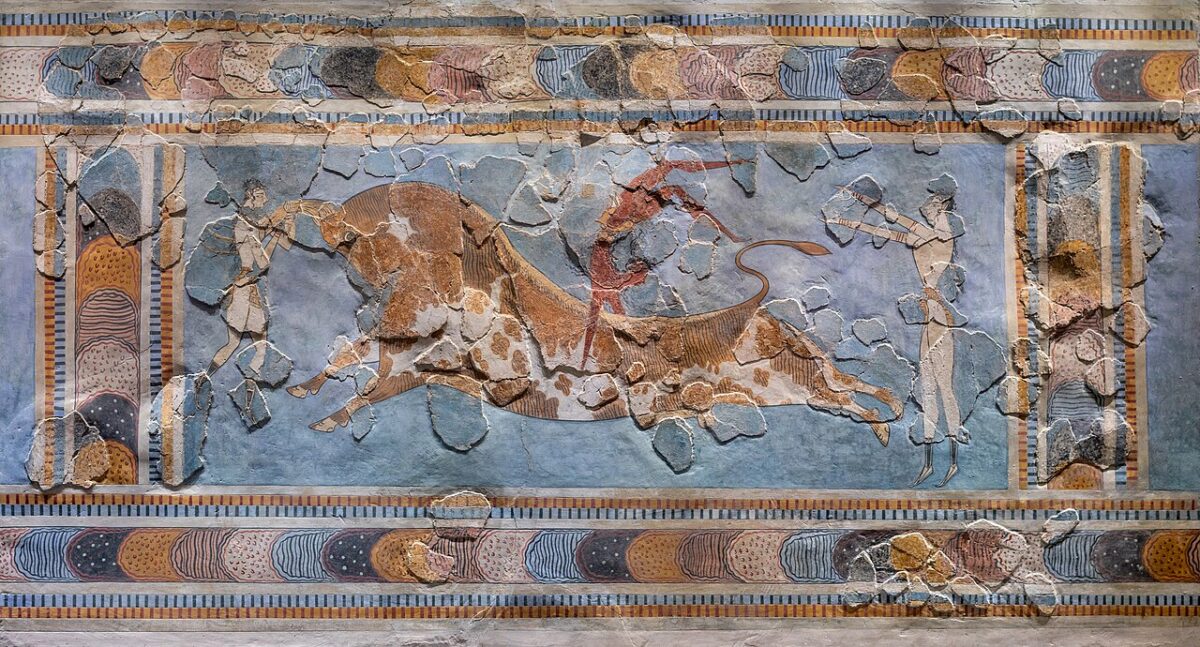
The most iconic piece of Minoan artwork is the Bull-Leaping fresco. This masterpiece captures a moment of extreme tension and grace, as a figure somersaults over the back of a charging bull. Beyond its artistic merit, the fresco provides vital clues about Minoan sports and ritual life. The presence of both male and female figures (indicated by different skin tones) in such a dangerous activity suggests a society where gender roles were surprisingly fluid compared to later Greek periods.
Mastering Form: Minoan Art Sculpture and Figurines
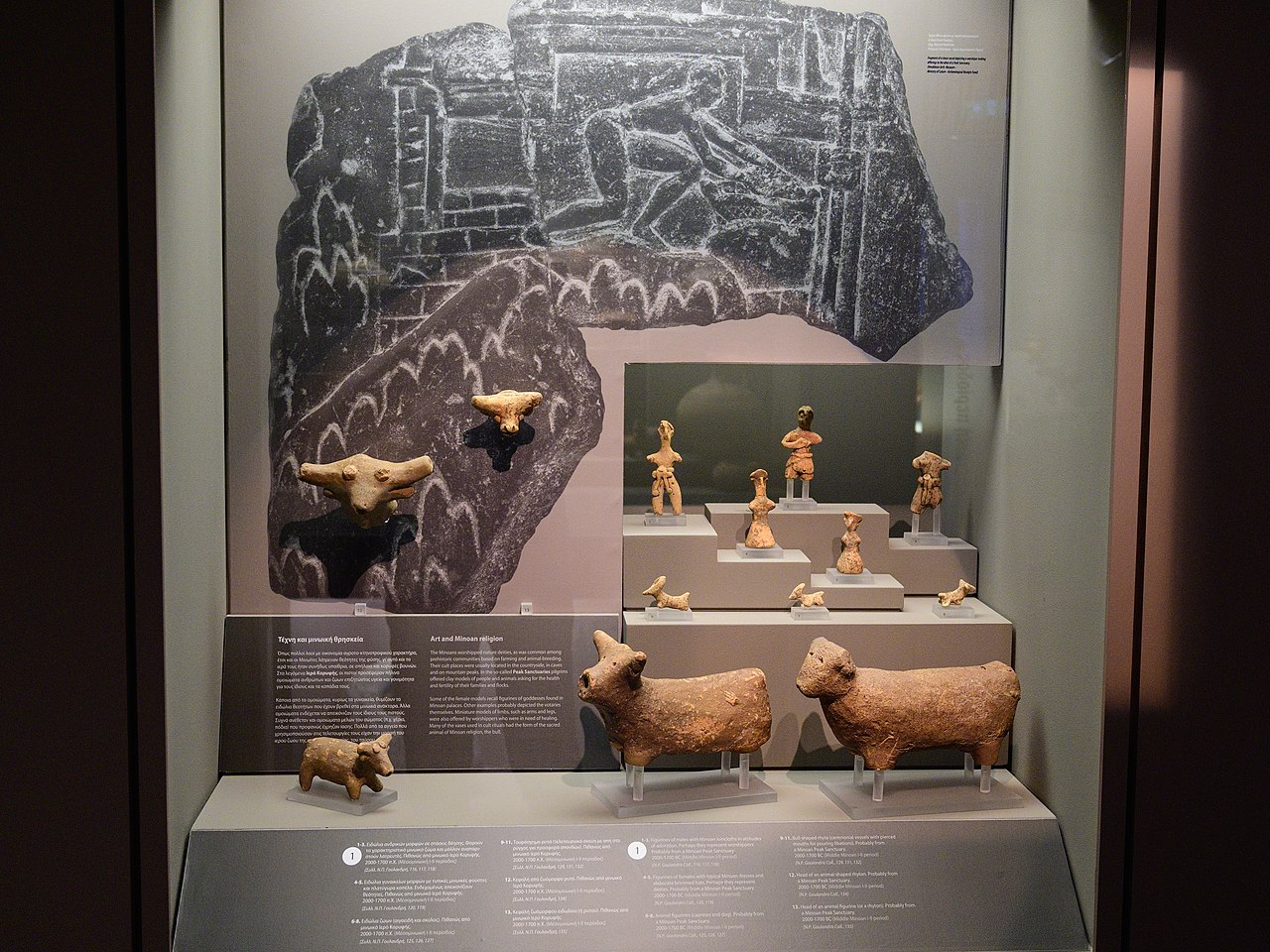
While the frescoes provide a two-dimensional window into their world, Minoan art sculpture adds a sense of tangible weight and craftsmanship. Minoan artisans worked with a variety of challenging materials, including ivory, bronze, faience, and terracotta, creating intricate figurines that served both religious and decorative purposes.
The Snake Goddess: Religion in Minoan Art Sculpture
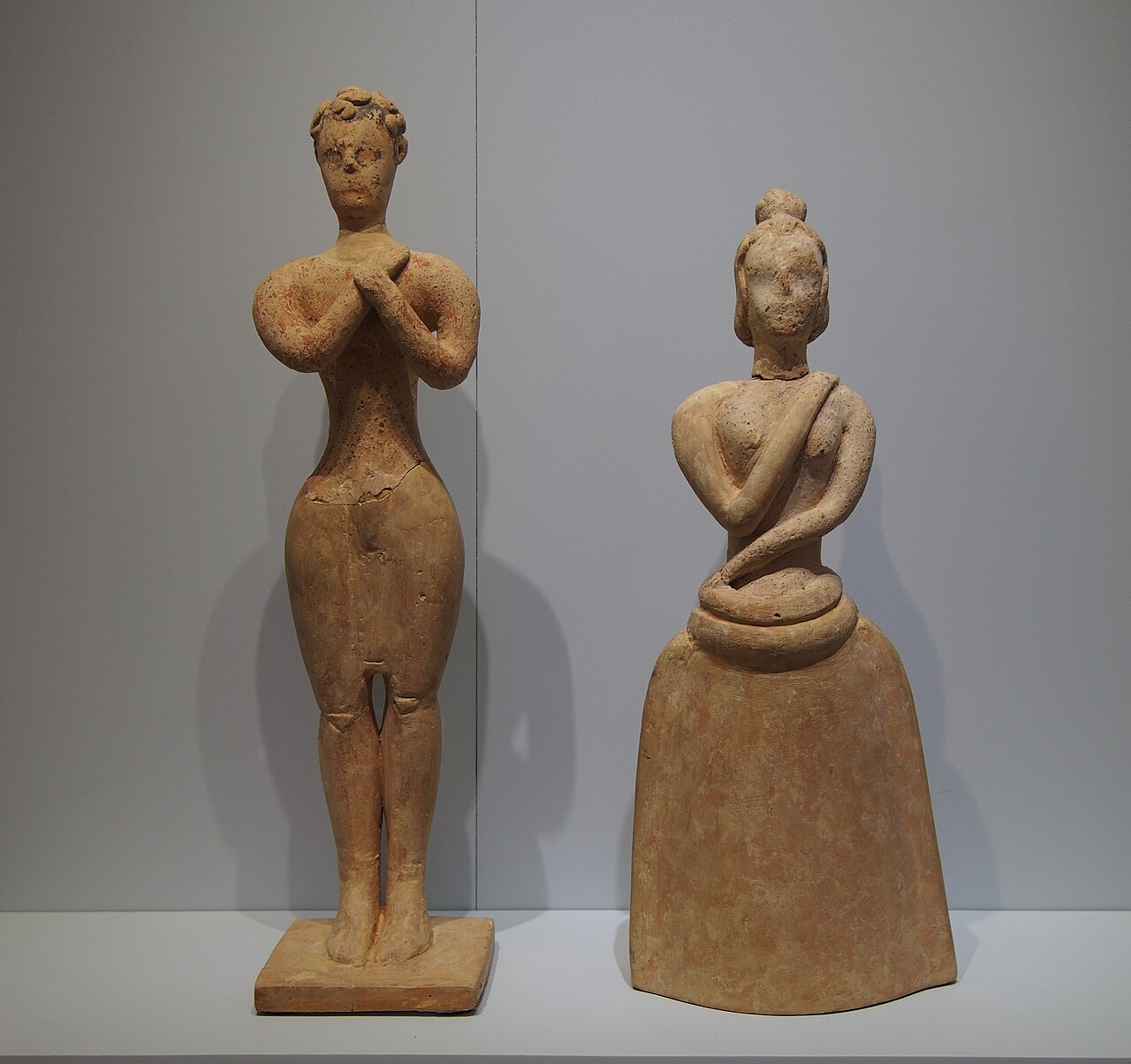
The „Snake Goddess“ figurines are the most famous examples of small-scale Minoan art sculpture. These faience figures, with their tiered skirts and serpents coiled around their arms, represent the peak of Minoan religious iconography. They showcase a high level of detail, from the intricate patterns of their bodices to the fierce, wide-eyed expressions that suggest divine power.
Ivory and Chryselephantine Masterpieces
The height of Minoan art work in sculpture can be seen in their luxury items made of „chryselephantine“ (gold and ivory). The „Palaikastro Kouros“ is a prime example; a stunning statuette made of hippopotamus ivory, gold, and serpentine. These pieces demonstrate that the Minoans were part of a vast trade network, importing rare materials to create high-status art.

Pottery And Ceramic Traditions of The Minoans
Ceramics were the „industrial art“ of Crete, evolving from simple, hand-made vessels into sophisticated, wheel-thrown masterpieces that were exported throughout the ancient world.
Kamares Ware: The Height of Polychrome Ceramics
In the Middle Minoan period, Minoan art work reached a peak with Kamares Ware. These vessels are famous for their „eggshell“ thinness and vibrant polychrome designs. Swirling whites, reds, and oranges against a dark background created a visual rhythm that mimicked the movement seen in their frescoes.
The Marine Style: Sea Life Captured in Clay
Later in their history, the „Marine Style“ became dominant. Here, the pottery becomes a canvas for the ocean. Octopuses with undulating tentacles wrap perfectly around the curves of jars and stirrup-vases. Showing how Minoan artwork always respected the harmony between the object’s form and its decoration.
Minoan Seal Stones and Glyptic Art
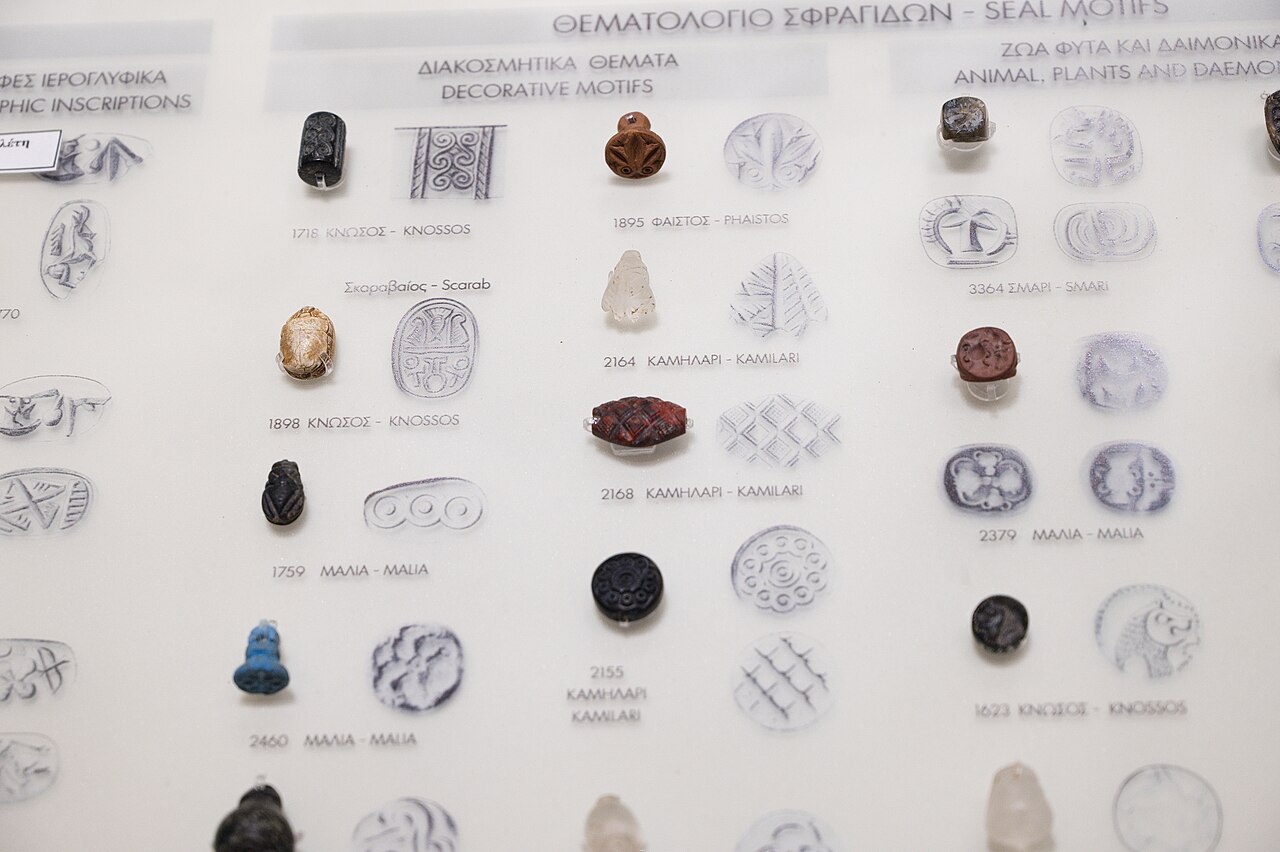
Some of the most incredible Minoan art sculpture exists on a miniature scale. Seal stones, used for identification and administration, were carved from hard gems like agate, jasper, and carnelian.
Micro-Sculpture: The Intricacy of Minoan Seals
These seals are masterpieces of micro-sculpture. Despite being often less than an inch wide, they depict complex scenes of religious processions, animal hunts, and intricate architecture. They are an essential source for historians studying Minoan clothing and daily life.
Jewelry and Goldsmithing: Luxury in Minoan Art Work
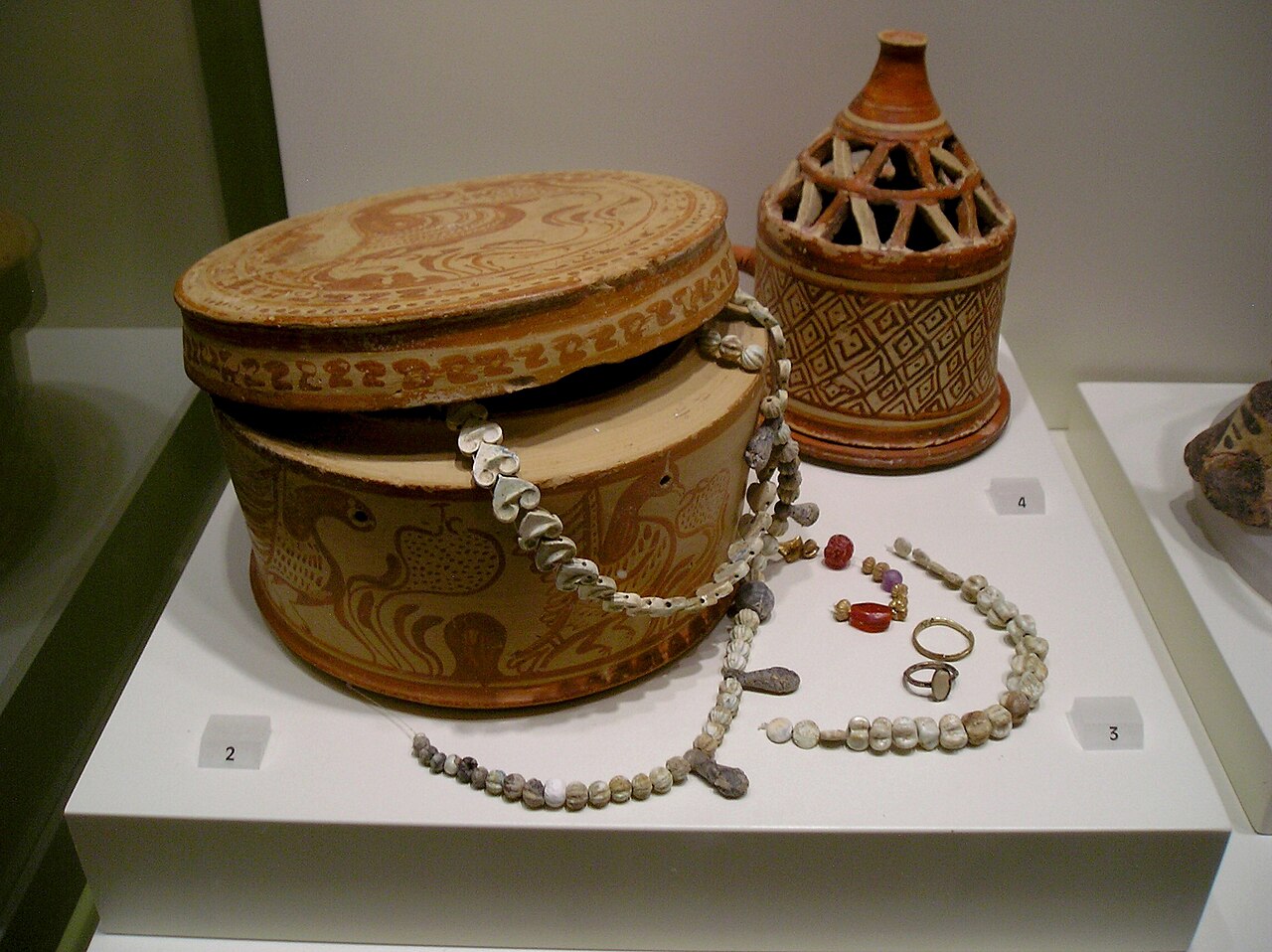
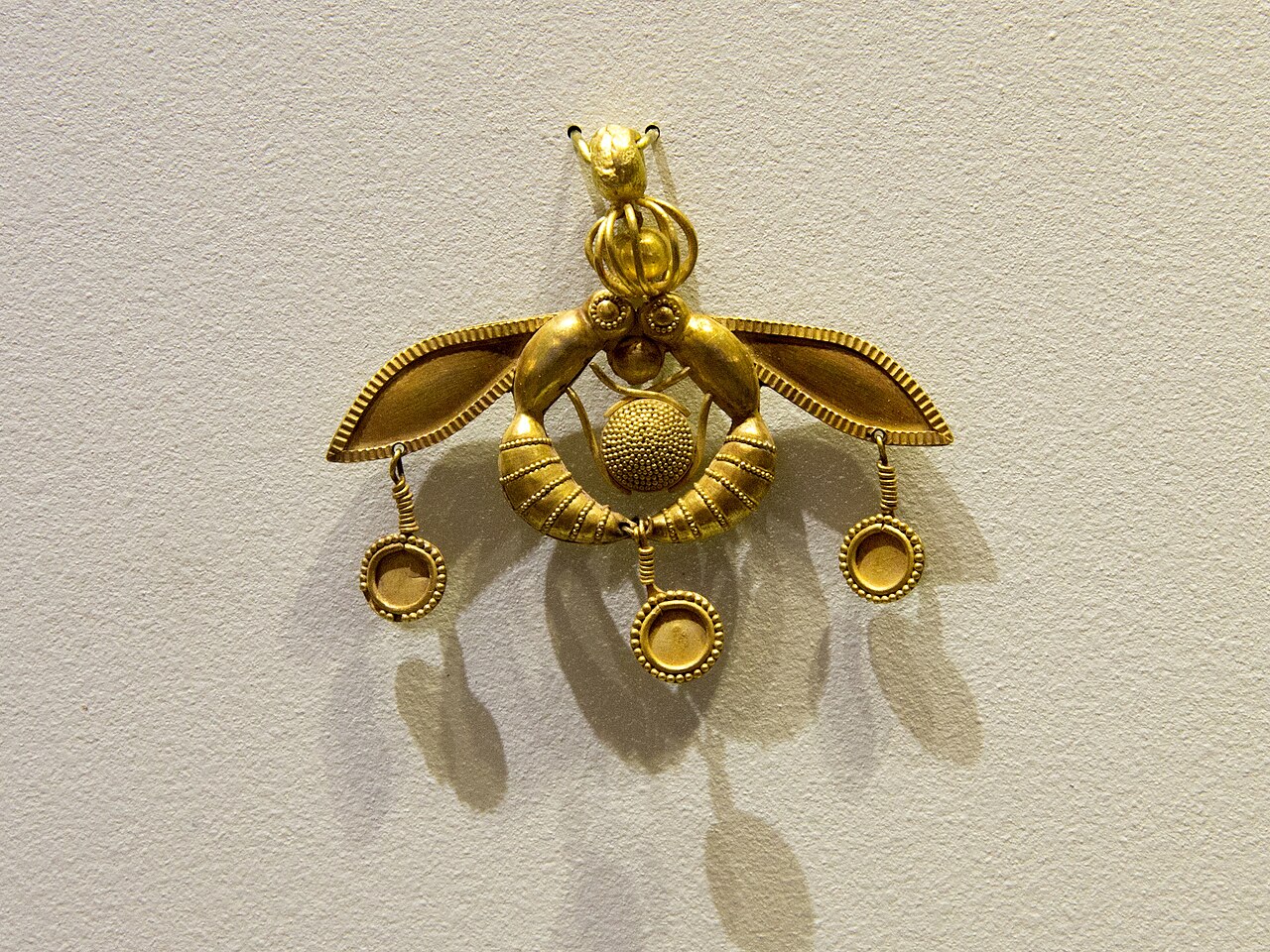
The Minoans were master goldsmiths. Their Minoan art work in jewelry utilized advanced techniques like granulation (fusing tiny gold spheres to a surface) and filigree. The famous „Malia Honeybee“ pendant, featuring two bees sharing a drop of honey, is a marvel of delicate precision that modern jewelers still struggle to replicate.
Ritual Vessels and Stone Carving
Stone carvers produced „rhyta,“ or libation vessels, often carved from steatite or serpentine. The „Harvester Vase“ and the „Boxer Vase“ are narrative stone Minoan artwork at its best. Showing crowds of men in rhythmic motion, their muscles and expressions carved with a startling degree of realism.
The Role of Women and Gender in Minoan Art
One cannot discuss Minoan painting without noticing the prominence of women. From the „Ladies in Blue“ to the „Parisienne,“ women are depicted as central figures in religious and social life. They appear with elaborate hairstyles, sophisticated jewelry, and powerful stances. Suggesting that Minoan society afforded Minoan women a level of status unseen in the contemporary Near East.
Fashion and Status in the Frescoes of Akrotiri
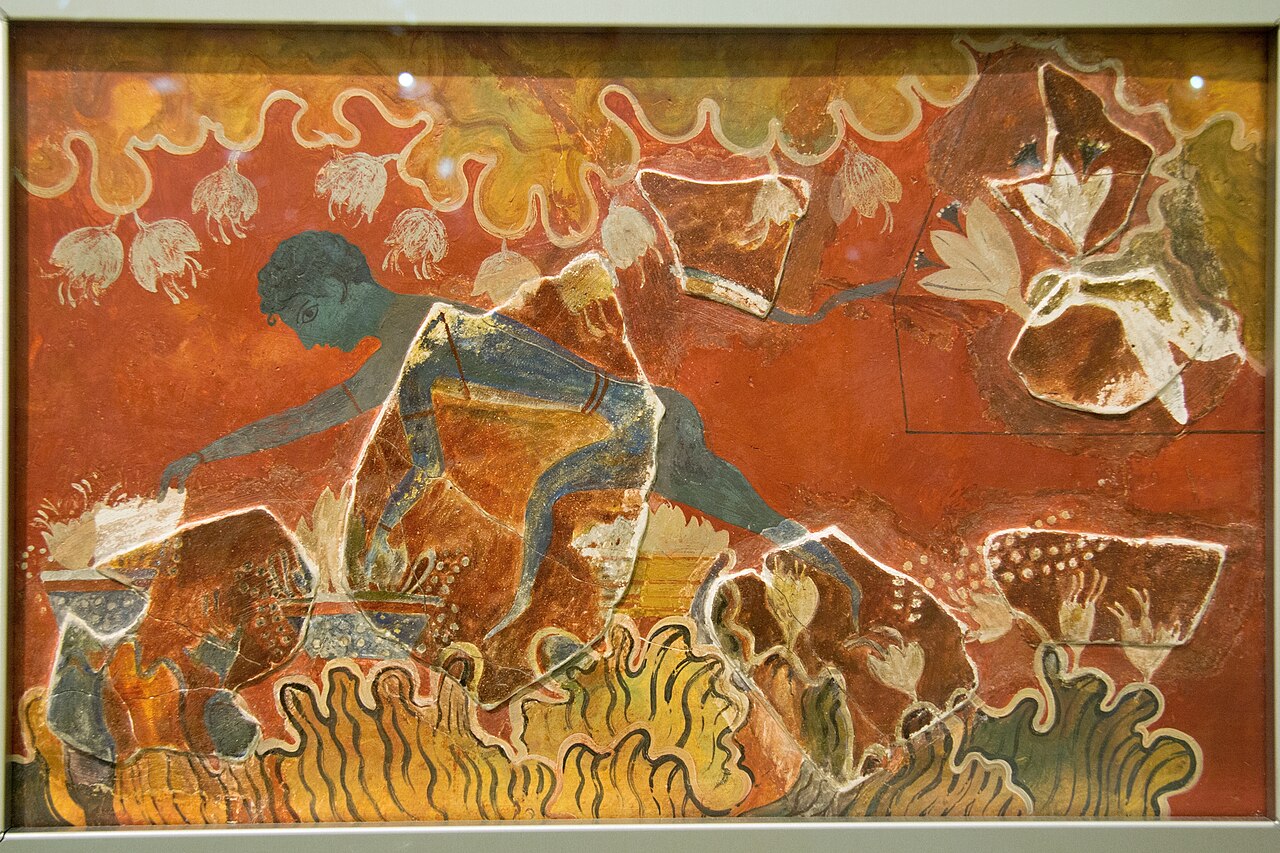
The frescoes from Akrotiri (on modern-day Santorini) offer the best look at Minoan fashion. The „Saffron Gatherers“ fresco shows women in colorful, multi-layered textiles, proving that Minoan painting was as much about documenting social status and high-fashion as it was about nature.
Architecture And Its Synthesis With Minoan Art
Minoan art was never meant to be isolated; it was part of the architecture itself. The „Palace Style“ created an immersive environment where the walls, floors, and columns worked together to tell a story.
Lustral Basins And Pier-And-Door Partitions
Architectural features like lustral basins (sunken rooms for ritual cleansing) served as the stage for the display of Minoan art work. These spaces were designed to control light and shadow, enhancing the visual impact of the colorful frescoes and sculptures within.
The Cultural Impact And Legacy of Minoan Art
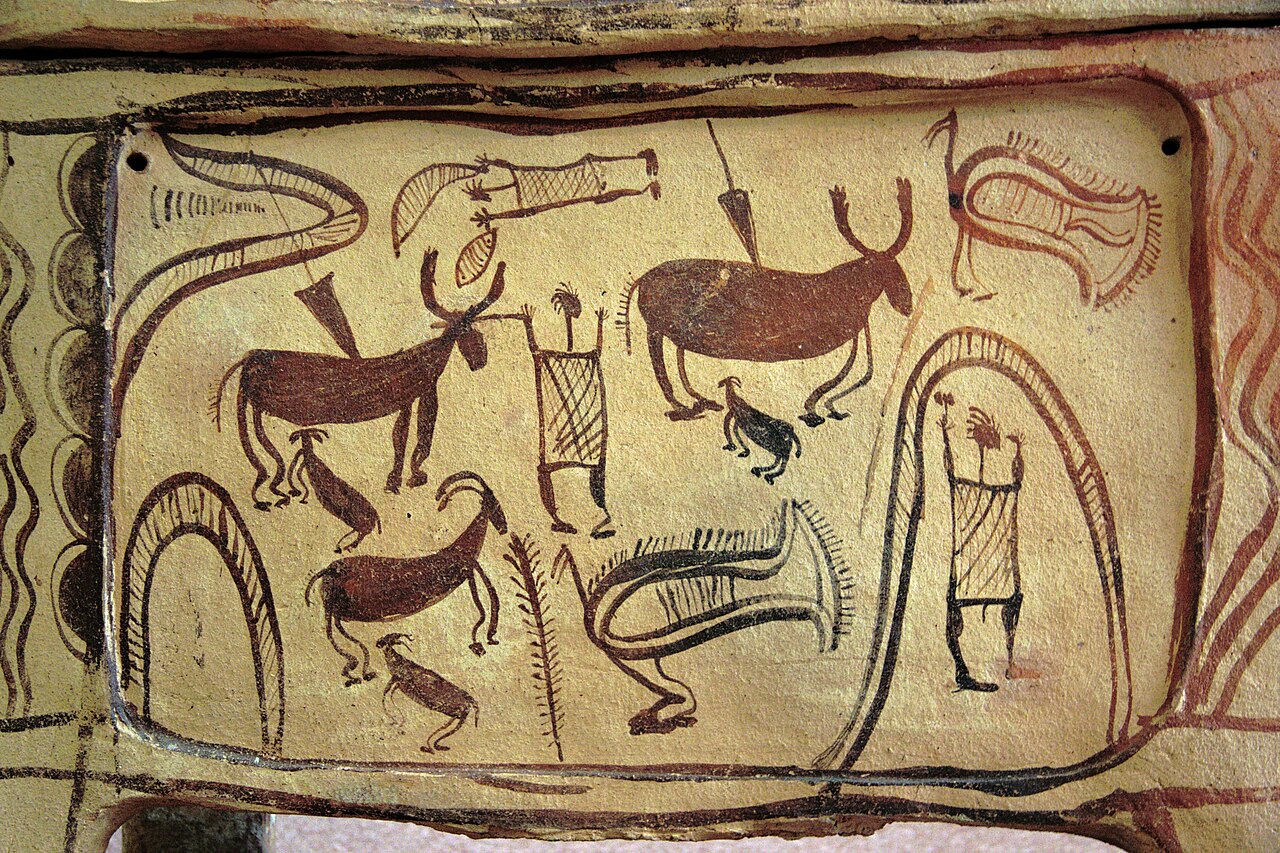
The legacy of Minoan art did not vanish with the fall of their palaces. It served as the foundation for the Mycenaeans on the Greek mainland, who adopted Minoan styles for their own palaces.
Minoan Influence On Mycenaean Painting
While the Mycenaeans took the techniques of Minoan painting, they changed the mood. The peaceful landscapes of Crete were replaced with hunting scenes and warriors, showing how a style can be adapted to fit a more militaristic culture.
Minoan Art in Modern Museums: Where to See it
If you want to experience the power of Minoan artwork firsthand, the Heraklion Archaeological Museum in Crete is the ultimate destination. It houses nearly all the major frescoes and sculptures mentioned in this article.
The Controversy of Restoration in Minoan Art Work
It is worth noting the debate surrounding the restorations at Knossos. Sir Arthur Evans used a great deal of „artistic license“ in piecing together the frescoes. While this makes the Minoan art work more accessible to the public, scholars often debate where the ancient paint ends and the modern interpretation begins.
Technical Achievements: Firing and Pigments
The Minoans were technical innovators. They sourced pigments from natural minerals, lapiz lazuli for blue, hematite for red. Plus, they managed sophisticated high-temperature kilns to produce their Minoan art sculpture and ceramics, ensuring their creations would last for four millennia.
The Enduring Mystery of the Phaistos Disc
No discussion of Minoan artwork is complete without the Phaistos Disc. This unique clay disc, stamped with 241 symbols in a spiral, remains undeciphered. It stands as a silent sentinel of the artistic and intellectual mystery that still surrounds this civilization.
Summary of Iconic Minoan Masterpieces
For those looking for a „quick-start“ guide to Minoan art, here are the five essential pieces to know:
-
The Bull-Leaping Fresco (Knossos)
-
The Snake Goddess Figurine (Knossos)
-
The Malia Honeybee Pendant (Malia)
-
The Octopus Vase (Palaikastro)
-
The Harvester Vase (Agia Triada)
Experience Minoan Art Firsthand
Nevertheless, while articles and books provide knowledge, experiencing Minoan Art firsthand is an entirely different realm. Imagine standing in front of a millennia-old fresco, each brushstroke telling tales of celebrations, rituals, and ordinary moments.
If the world of Minoan Art has sparked your interest, why restrict yourself to just reading? Dive deeper into the heart of Crete. Plan a personalized journey, steeped in history and beauty, with Elissos Travelling Philosophy.
Crete’s Minoan Art legacy is a testament to an island that has always been at the crossroads of culture, history, and artistry. Every fresco, pottery piece, and sculpture shares tales from an era long gone, yet their charm remains eternally captivating.
Finally, for those with a yearning to explore the world of Minoan Art, consider reaching out to the expert travel designers at operation@elissos.com. With Elissos Travelling Philosophy, you’re not just witnessing history; you’re living it. Dive into the heart of ancient Crete and let its stories unfold before you. Your adventure awaits!
Conclusion
Minoan artwork is more than just a collection of ancient artifacts. It is the visual record of a people who viewed the world with wonder and creativity. From the grand scale of the Knossos frescoes to the microscopic detail of a seal stone, Minoan art remains a cornerstone of European history, reminding us that the impulse to create beauty is as old as civilization itself.
Feature image: Knossos bull leaping fresco, photograph by Gleb Simonov, via Wikimedia Commons, CC0 1.0. No changes were made.