
Easter in Crete: Orthodox Traditions, Holy Week Rituals, and the Feast of Pascha
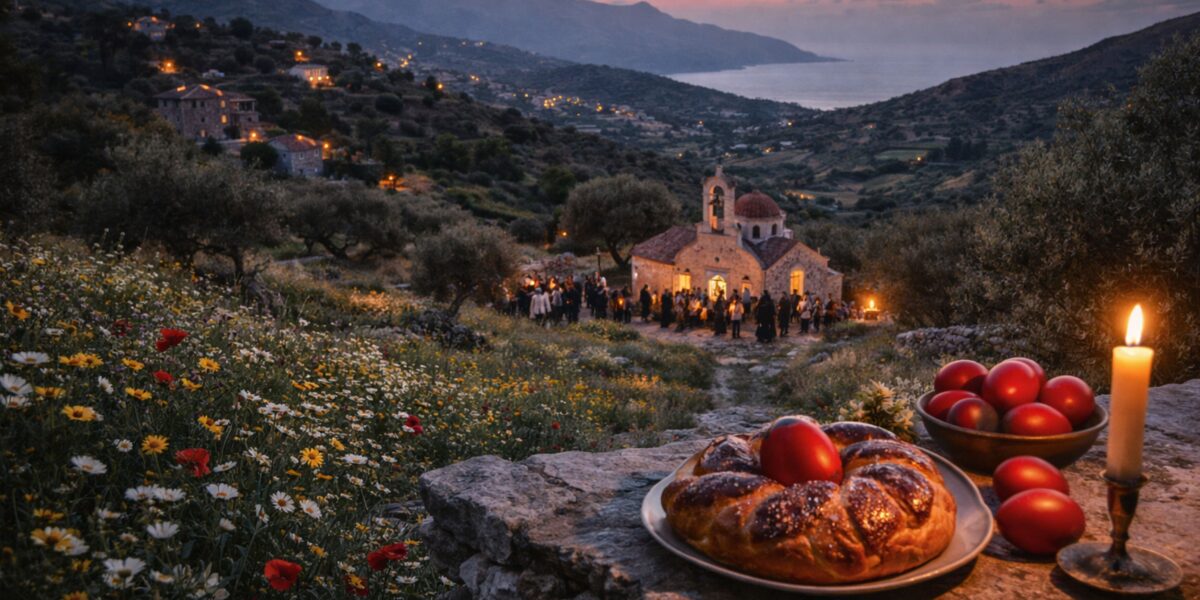
Easter in Crete is unlike almost any other celebration you will find in the Mediterranean.
It is not a long weekend with painted eggs and chocolate. It is a full week of deeply lived ritual, communal preparation, solemn ceremony, and finally, an explosion of joy that the whole island waits for together.
For Cretans, Easter is not simply the most important Christian holiday. It is the anchor of the year, a moment when families return to their home villages from across Greece and abroad, when the rhythms of fasting give way to the smell of roasting lamb, and when centuries-old Orthodox traditions are performed exactly as they have always been.
If you are planning to visit Crete during this period, here is what you need to know. In 2026, Orthodox Easter in Crete falls on Sunday, April 12. Holy Week begins on Palm Sunday, April 5, and the celebrations continue through Easter Monday on April 13.
Easter in Crete, known locally as Pascha, is the most significant religious and cultural event of the year on the island. It follows the Greek Orthodox calendar, which means it often falls one to five weeks after Western Easter. Holy Week begins on Palm Sunday and leads through solemn ceremonies, including the Good Friday Epitaphios procession and the midnight Resurrection Service on Holy Saturday, where the Holy Flame is passed from person to person in darkened churches. Easter Sunday centers on the spit-roasted lamb feast shared with family and friends, accompanied by kalitsounia, tsoureki, red eggs, raki, and traditional Cretan music. In 2026, Orthodox Easter falls on April 12.
Why Easter Is the Most Important Holiday in Crete
Greece is one of the most deeply Orthodox Christian countries in Europe, and Crete carries that identity with particular intensity. Christmas matters, of course. But among Cretans, the question is not whether Easter outranks all other occasions. It simply does.
The reason runs deeper than religion alone. During the centuries of Venetian and Ottoman rule, the Orthodox Church and its calendar were central to how Cretan communities held themselves together. Holy Week was not merely a private act of faith. It was a public statement of identity, of continuity, of belonging to something that could not be taken away. That history is still felt today, especially in the island’s villages.
Modern Crete is busy, connected, and increasingly cosmopolitan. But every spring, the island steps back into something older. Bakeries fill with tsoureki. Village squares prepare bonfires. Families who have spent the year scattered across the mainland or abroad make the journey home. Easter is when Crete remembers what it is.
When Is Easter in Crete? Orthodox vs. Western Easter Dates
One of the most common points of confusion for international visitors is that Easter in Crete does not always fall on the same date as Easter in Western Europe or North America.
The Greek Orthodox Church calculates Easter using the Julian calendar rather than the Gregorian calendar. As a result, Orthodox Easter can fall anywhere from one to five weeks after Catholic or Protestant Easter, though the dates occasionally coincide, roughly once every four years.
In 2026, Orthodox Easter Sunday is April 12. Holy Week runs from Palm Sunday on April 5 through Easter Monday on April 13. Good Friday falls on April 10, and the critical midnight Resurrection Service takes place on the night of Saturday, April 11.
If you are traveling from abroad and want to attend the actual Easter celebrations rather than simply passing through, it is worth double-checking the Orthodox Easter date for your year. Searching for the current Orthodox Easter calendar before you book will save disappointment.
Holy Week in Crete (Megali Evdomada): Day by Day
The week leading up to Easter is called Megali Evdomada, or Holy Week. Each day is known as ‘Big’: Big Monday, Big Tuesday, and so on. This is when the island changes character. The mood deepens. Church services multiply. Shops begin to close earlier. The television and radio shift toward religious programming. And in every village, there is a palpable sense of preparation.
Palm Sunday: The Procession Begins
Holy Week opens on Palm Sunday with morning church services where woven palm crosses and olive branches are blessed and distributed. Many families take these home and place them in their iconostasis, the small household shrine common in Cretan homes. The tradition recalls the entry of Christ into Jerusalem, and the crosses made from date palm fronds are often crafted by hand in the days before, passed down as an intricate local art form.
Holy Thursday: Red Eggs and the Last Supper
Holy Thursday is one of the busiest domestic days of the week. This is when the red eggs are dyed. All over Crete, kitchen tables fill with bowls of brilliant red, the color representing the blood of Christ and, in a deeper and more instinctive way, the intensity of life itself.
Families also bake tsoureki on this day, the sweet braided bread flavored with mastiha or mahlepi that appears on every Easter table. In some households, the baking of kalitsounia (small Cretan cheese and herb pies) also begins. The kitchen becomes the center of the house.
Good Friday: The Epitaphios Procession
Good Friday, called Megali Paraskevi, is a day of mourning. Church bells ring a steady single toll through the morning. Music goes silent. Many shops close or keep subdued hours. The island holds itself quietly.
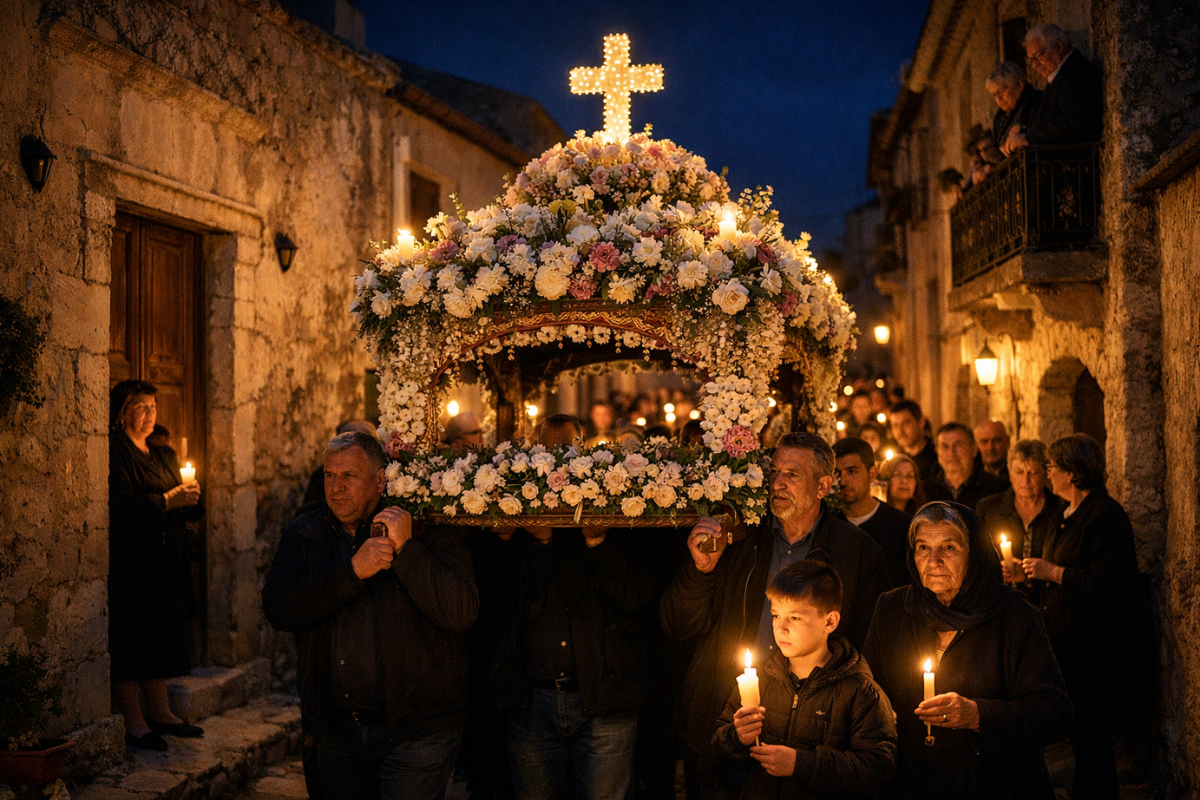
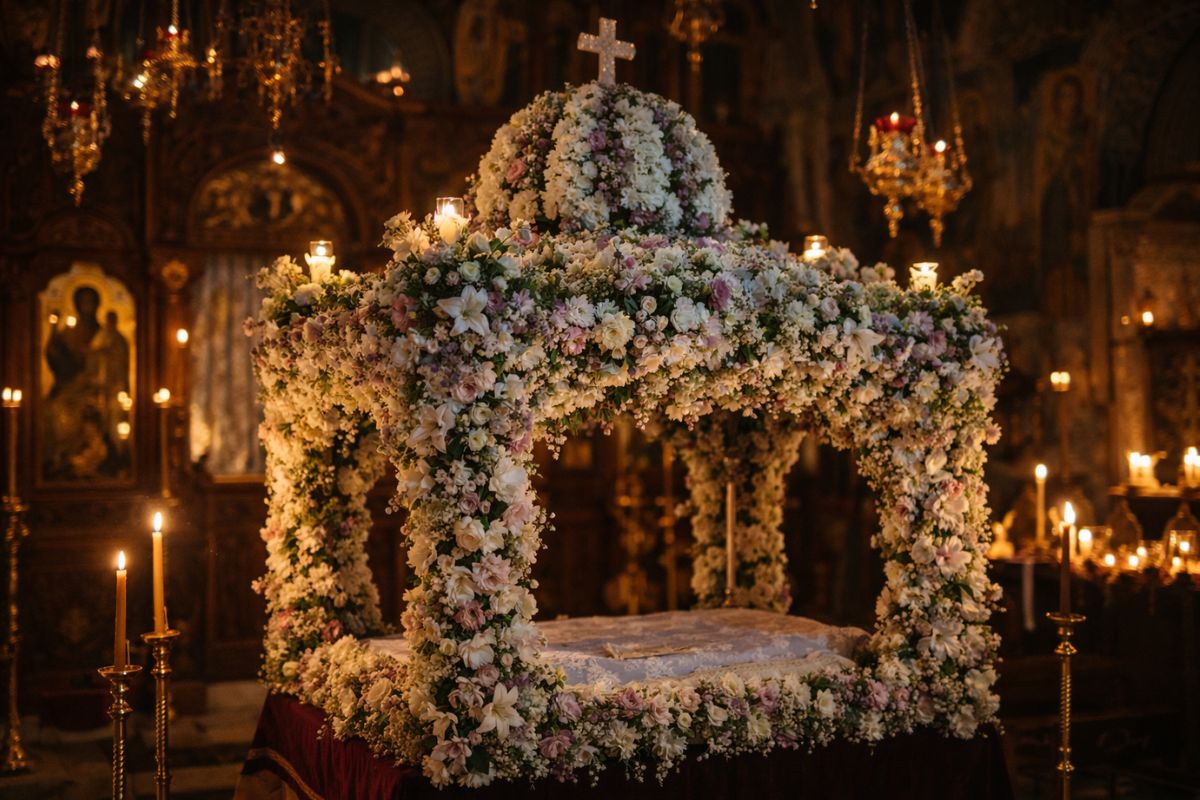
From early in the day, women and girls decorate the kouvouklion, the ornate bier representing Christ’s tomb, with white flowers and greenery. By evening, the bier is ready.
At around 8:30 PM, the Epitaphios procession begins. In every village and town across Crete, the flower-covered bier is carried slowly through the streets by young men, traditionally those about to begin military service, led by the priest and followed by the congregation dressed in black. People on balconies throw flower petals down. In some communities, the procession pauses at the local cemetery. Old women pass under the bier for a blessing. Candles flicker. Hymns rise in the darkness.
In the cities, including Heraklion, Chania, Rethymno, and Agios Nikolaos, these processions wind through entire city centers. But the experience in a smaller village is something different. The scale makes it intimate. You are not watching a ceremony. You are inside it.
Holy Saturday: The Midnight Resurrection
Holy Saturday, Megalo Savvato, builds all day toward midnight. Children collect wood for bonfires and construct effigies of Judas throughout the day. The rivalry between villages over who builds the biggest fire is genuine and good-natured. Fireworks are tested intermittently. The sense of anticipation grows.
By 11 PM, churches across Crete are filling. The service begins in candlelight, then full darkness, as the lights are extinguished to represent the passage of Christ through the underworld.
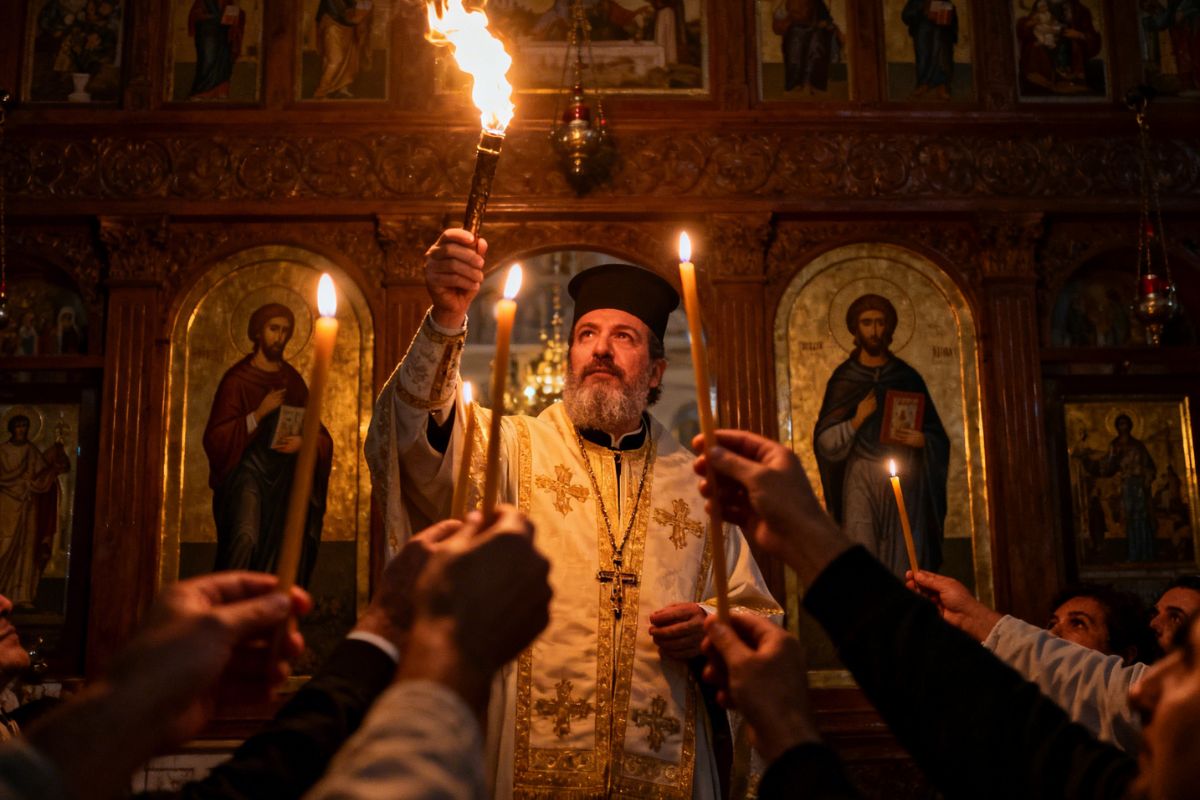
At exactly midnight, the priest appears from behind the altar screen holding a single lit candle and chants: ‘Avto to fos,’ meaning ‘This is the light of the world.’ He touches his flame to the candle of the nearest worshipper, who lights the next, and the next, until the entire congregation is holding light in the darkness.
Then the words: ‘Christos Anesti’ (Christ is Risen). The response: ‘Alithos Anesti’ (He has truly risen). Church bells ring. Fireworks fill the sky. The effigies of Judas are burned on their bonfires outside the churches.
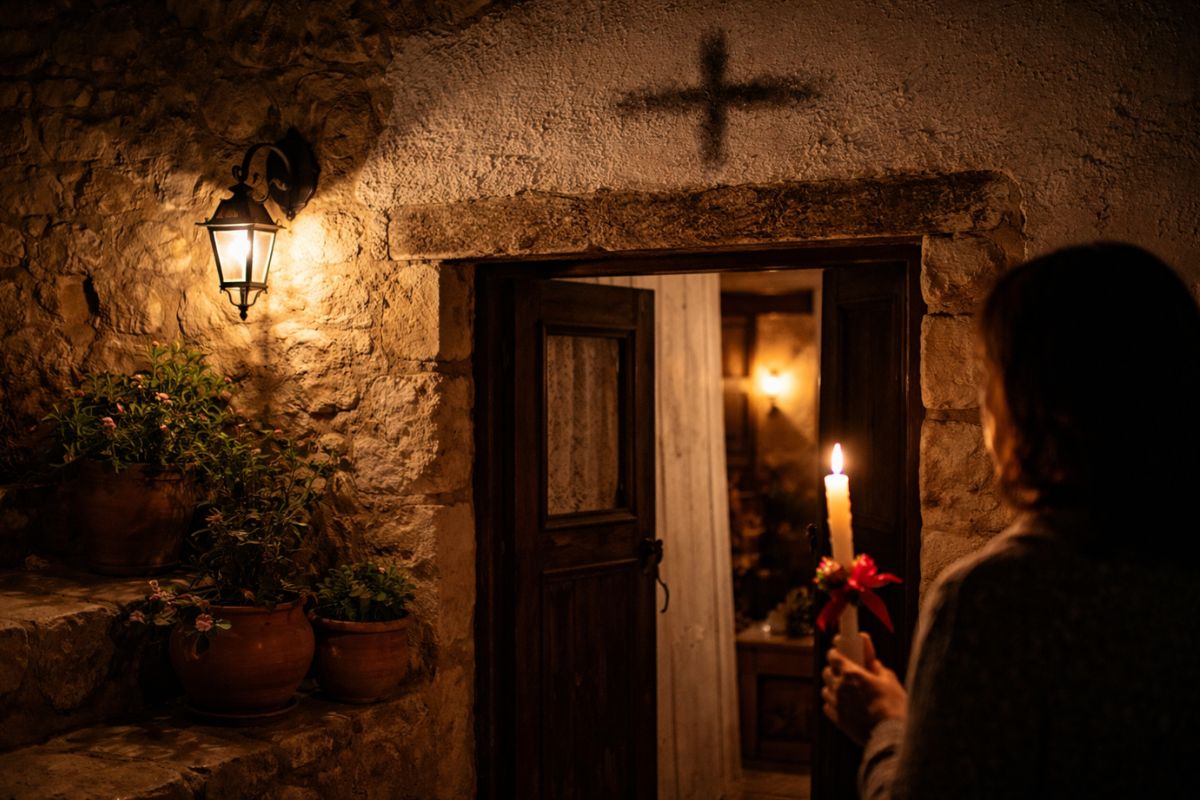
The tradition after the midnight service is to carry your candle home without letting it go out. At home, the flame is used to trace a small cross above the door of the house, a mark of blessing for the year ahead.
The first meal after the midnight fast is magiritsa, a slow-cooked soup made from lamb offal, rice, lemon, and herbs. Many families eat it at home. Others gather at tavernas that stay open through the night, often with live music.
Easter Sunday in Crete: The Great Feast
Easter Sunday, Kyriaki tou Paska, is the feast. The fast is over, and the island celebrates with everything it has.
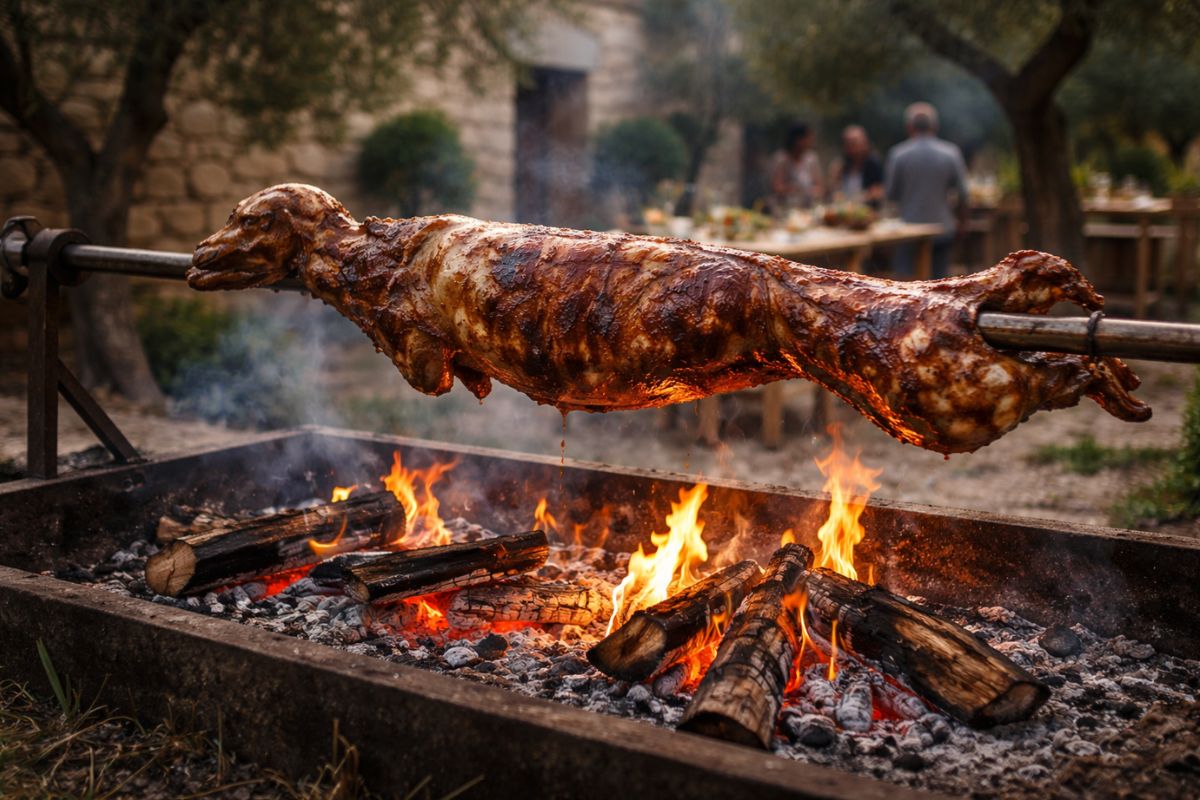
Preparations begin at dawn. Families tie the lamb to the spit, using wood from olive and grape vines to start the fire. The lamb, a symbol of Christ’s sacrifice, turns slowly for six hours or more. It is not unusual for the wine to begin flowing by 9 in the morning.
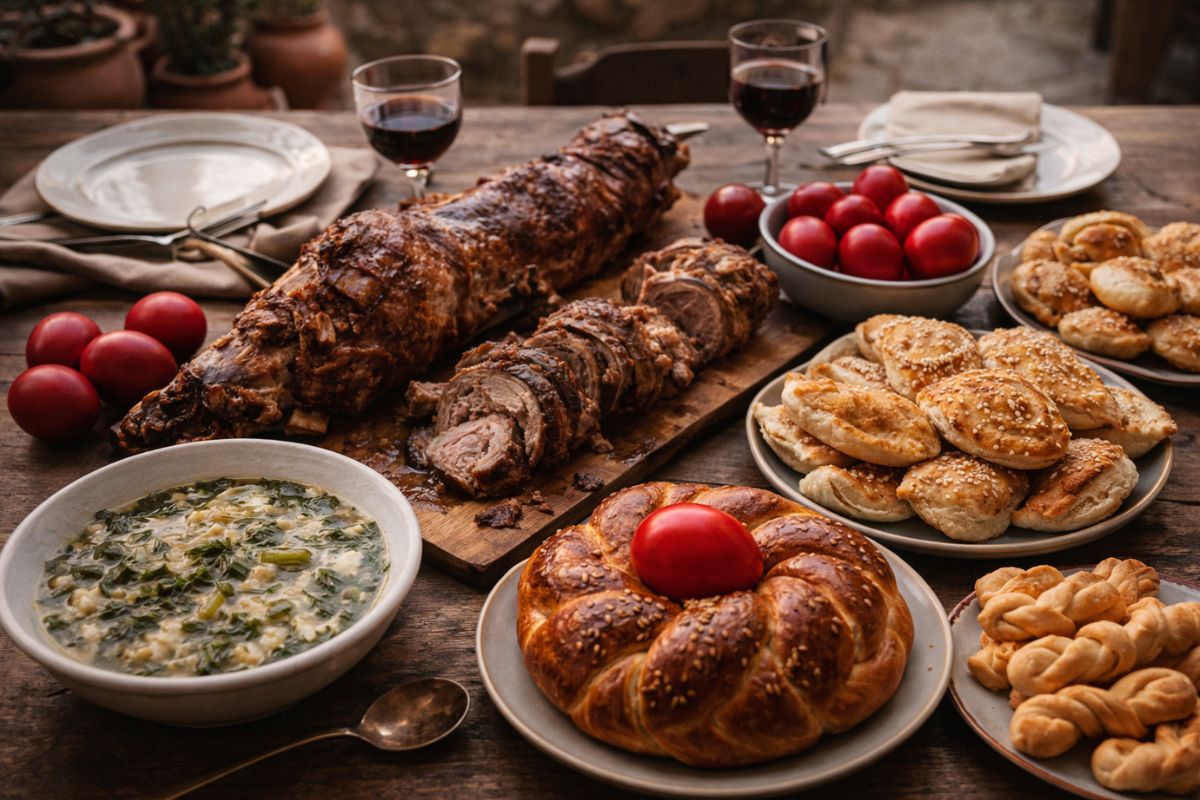
By early afternoon, extended families and friends gather around long outdoor tables. The traditional lamb arrives alongside kokoretsi (offal wrapped in intestines and slow-roasted), fresh salads, kalitsounia, tsoureki, and plenty of raki. The tsougrisma egg-cracking game takes place: two people tap their red eggs together; whoever’s egg survives wins, and the custom carries a wish for good fortune.
Music, usually traditional Cretan, fills the air. The lyra, the Cretan lute, and voices carry through open windows and courtyards. Dancing follows the meal. Neighbors visit each other’s tables. If you happen to be passing a celebration as a visitor, do not be surprised if someone calls out ‘Christos Anesti’ and waves you in. That is not unusual. Cretan hospitality at Easter is genuine and open.
Shops, museums, and most archaeological sites are closed on Easter Sunday. Tavernas are generally open, especially from midday onward.
Easter Monday is a public holiday and a day of rest. Leftovers from Sunday are shared again, often with more of the same music and company. The main archaeological sites, including Knossos and Phaistos, typically reopen on Monday.
Traditional Easter Food in Crete
Easter food in Crete is specific, seasonal, and deeply attached to the meaning of the occasion. Every dish carries a purpose.
Magiritsa is the first meal after the midnight service, a slow-cooked soup made from lamb offal, rice, dill, spring onions, and egg-lemon sauce. It breaks the 40-day fast gently.
Spit-roasted lamb dominates Easter Sunday. The whole animal, seasoned simply with salt, pepper, lemon, and oregano, turns over an open wood fire for most of the morning.
Kokoretsi is made from lamb or goat offal, wrapped tightly in intestines and roasted on a separate spit alongside the lamb. It is an acquired taste and a non-negotiable part of the Easter table.
Kalitsounia are small Cretan pastries filled with fresh myzithra cheese and herbs. They appear in both savory and sweet versions throughout the Easter period. The Cretan version is distinct from what you find elsewhere in Greece.
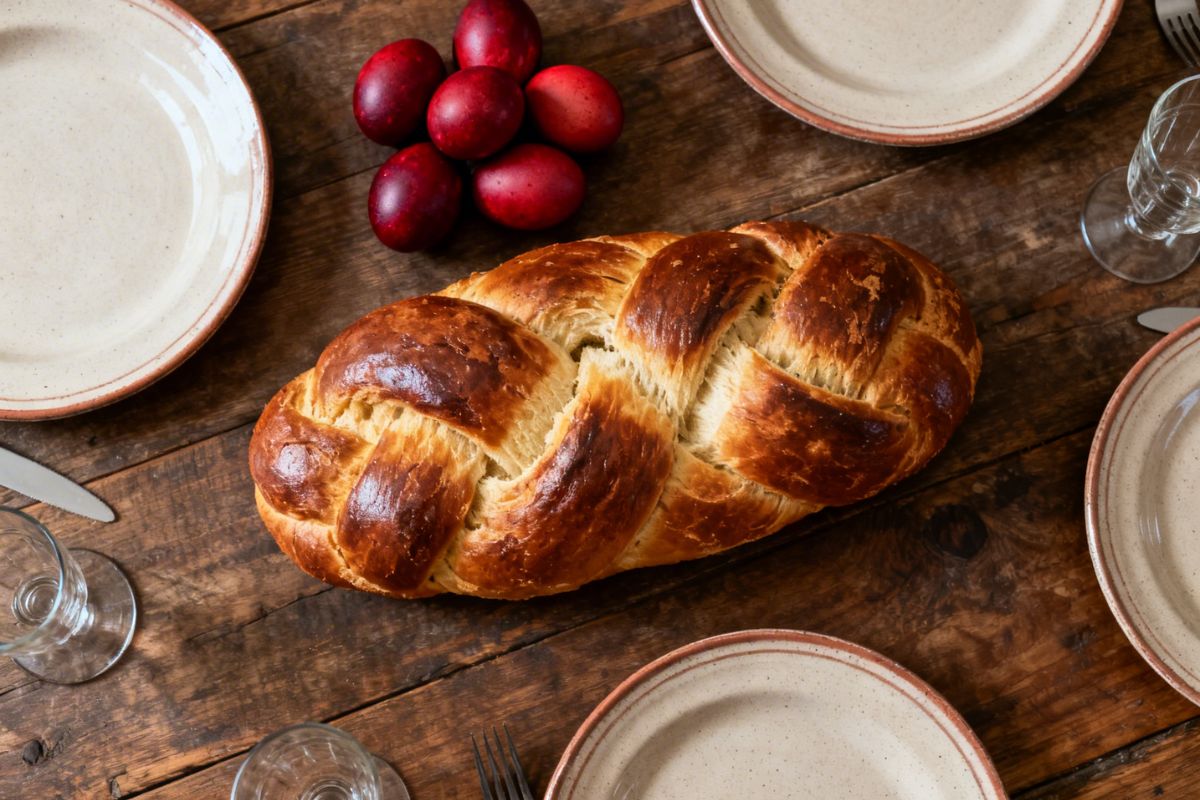
Tsoureki is the sweet braided bread, flavored with mastiha or mahlepi, often baked with a red egg pressed into the dough. It is a staple of the Easter table and given as a gift between families and godparents.
Red eggs (kokkina avga) are dyed on Holy Thursday. They represent the blood of Christ and are placed throughout the house and on the Easter table. The egg-cracking game on Easter Sunday is one of the most enjoyed traditions for both children and adults.
Koulourakia are twisted butter cookies, often prepared alongside tsoureki and given to visitors and neighbors during Holy Week.
Crete-Specific Easter Customs
While the broad structure of Orthodox Easter is shared across Greece, Crete has its own particular character.
The burning of Judas is performed in virtually every Cretan village on Holy Saturday night. The effigy, built throughout the day by local children and teenagers, is lit after the midnight service to the sound of fireworks and cheering. The size of the bonfire is a matter of local pride.
The Holy Flame from Jerusalem arrives in Athens by plane on Holy Saturday and is distributed to churches across Greece and Cyprus. In Crete, the flame reaches local churches in time for the midnight service, and carrying it home without letting it die is taken seriously.
The cross above the door is traced in smoke from the Easter candle as each family returns home after the midnight service. Many Cretan homes still show this mark above the entrance.
Village rivalry over bonfires is a longstanding tradition. Communities compare the height and intensity of their fires. Young people gather wood for days in advance.
In the village of Anogeia, known for its fierce local identity and strong Cretan character, Easter is particularly striking. The same is true of Archanes, Vamos in the west, and Alagni in the Heraklion region, where local artists have added decorative murals to the village plateia. These places offer a version of Easter that has not been softened or adapted for visitors.
Where to Experience Easter in Crete
The cities offer scale. Heraklion, Chania, Rethymno, and Agios Nikolaos all hold impressive Epitaphios processions that wind through city centers and can draw large crowds. These are worth attending, especially for first-time visitors who want the full theatrical weight of the ceremony.
But the villages are where Easter in Crete shows its real depth. In a smaller community, the ceremonies are not organized for spectators. They are organized for the community itself, which means that as a visitor you are stepping into something alive rather than watching something performed.
Some of the most recommended villages for Easter include Anogeia in the Rethymno plateau, known for its intensity and strong musical tradition; Archanes near Heraklion, with well-organized celebrations and good access; Vamos in the Apokoronas area of western Crete, known for actively preserving traditional Easter customs; and Alagni, where local art transforms the village plateia during Holy Week.
If you are traveling independently, a rental car gives you the flexibility to move between village celebrations. Public transport operates on a reduced schedule during Easter, so it is worth planning your movements in advance.
Practical Tips for Visiting Crete During Easter
Easter is one of the busiest travel periods in Greece. Cretans living on the mainland return home in large numbers, and international visitors are increasingly drawn to the island specifically for this occasion. Here is what to keep in mind.
Book accommodation early. Rooms in popular areas and village guesthouses often fill several months in advance. If you want to stay in or near a village rather than a city, start planning well ahead.
Respect the solemnity of Good Friday. This is a day of mourning, and the atmosphere reflects that. Loud music, large public gatherings for recreational purposes, and disruptive behavior near churches are genuinely unwelcome.
Dress appropriately for church services. Both men and women should cover shoulders and knees when attending religious ceremonies. A light layer or scarf is practical and respectful.
Learn a few words. Knowing how to say ‘Christos Anesti’ and respond ‘Alithos Anesti’ will open more doors than you expect. Cretans notice and appreciate it.
Expect closures. Good Friday, Easter Sunday, and Easter Monday are all treated as significant holidays. Many shops, archaeological sites, and government offices will be closed. Plan any essential logistics around this.
Spring weather in Crete. April temperatures in Crete typically range from 17°C to 22°C (63°F to 72°F) during the day, with cooler evenings. Rain is possible. Pack a light layer and comfortable walking shoes for processions.

Easter in Crete and the Island’s Deeper Story
There is something worth understanding about why Easter in Crete carries the weight it does, beyond religion and beyond tradition as a cultural habit.
Crete has a long and often difficult history. Under centuries of Venetian and Ottoman presence, the Orthodox calendar was not simply a religious framework. It was one of the primary ways the island’s communities maintained their sense of self. Holy Week and the feast of Pascha were public acts of identity. To participate was to stand inside a chain of continuity that stretched back through grandparents, priests, shepherds, and village elders.
That understanding is still present in the way Easter is observed here, particularly in the villages. The ceremonies are not preserved as folklore. They are lived as living practice, by people who know exactly what they are doing and why. Visitors who come with curiosity and genuine respect for that will find themselves welcomed in ways that rarely happen during the busy summer season.
If you are drawn to Crete for its depth, it’s art, its mythology, its sacred landscapes, and its connection to something older than conventional tourism, Easter is one of the most meaningful times to be here. The island is at its most honest, most communal, and most beautiful during Holy Week.
Conclusion
Easter in Crete is the most important week of the Cretan year, and for good reason. From the solemn candlelit processions of Good Friday to the midnight fireworks of Holy Saturday and the long lamb feasts of Easter Sunday, it offers something that no beach resort or archaeological tour can replicate: genuine access to how this island lives.
Orthodox Easter in Crete follows the Julian calendar, and in 2026 it falls on April 12. Planning your visit around Holy Week means planning carefully, booking early, and arriving with an open and respectful curiosity. Do that, and you will leave with an understanding of Crete that goes far deeper than its ruins and its coastline.
If you are drawn to exploring Crete through its cultural depth, its sacred traditions, and its local rhythms rather than its tourist highlights, the Easter period is one of the most powerful times to experience the island as it truly is.
FAQ SECTION
Frequently Asked Questions About Easter in Crete
When is Easter in Crete in 2026?
In 2026, Orthodox Easter in Crete falls on Sunday, April 12. Holy Week begins on Palm Sunday, April 5, and culminates in the midnight Resurrection Service on Holy Saturday, April 11.
Is Easter a good time to visit Crete?
Yes. Easter is one of the most rewarding times to visit Crete. The island is alive with genuine local celebrations, the weather is mild, the wildflowers are in bloom, and visitors often find themselves welcomed into community events that are not designed for tourism.
What is the Epitaphios procession in Crete?
The Epitaphios is a flower-decorated bier representing Christ’s tomb. On Good Friday evening, it is carried through village and town streets in a solemn candlelit procession led by the priest, followed by the congregation dressed in black. It is one of the most moving ceremonies of Orthodox Holy Week.
What food is eaten at Easter in Crete?
Traditional Easter food in Crete includes magiritsa (lamb offal soup eaten after the midnight service), spit-roasted lamb and kokoretsi on Easter Sunday, kalitsounia (Cretan cheese pies), tsoureki (sweet braided bread), koulourakia (butter cookies), and red-dyed eggs. Raki and local wine are always present at the Sunday feast.
What does ‘Christos Anesti’ mean?
‘Christos Anesti’ means ‘Christ is Risen’ in Greek. It is the traditional greeting exchanged at the moment of the Resurrection announcement on Holy Saturday midnight, and continues to be used as a greeting throughout the Easter period. The response is ‘Alithos Anesti,’ meaning ‘He has truly risen.’
Which Cretan villages are best for experiencing Easter?
Villages such as Anogeia, Archanes, Vamos, and Alagni are known for their authentic and deeply felt Easter celebrations. Smaller communities tend to offer a more intimate experience, where visitors may find themselves genuinely welcomed into the processions, bonfires, and Sunday feasts.
How is Greek Orthodox Easter different from Western Easter?
Greek Orthodox Easter is calculated using the Julian calendar rather than the Gregorian calendar used by Catholic and Protestant churches. As a result, the dates differ in most years, often by one to five weeks. Greek Orthodox Easter also places much greater emphasis on Holy Week ceremonies, the midnight Resurrection service, and the communal nature of the celebrations.
Do businesses close during Easter in Crete?
Good Friday and Easter Sunday are treated as deeply observant days. Many shops, museums, and archaeological sites close. Easter Monday is a public holiday. However, tavernas generally remain open, especially after the midnight service. Some major sites like Knossos and Phaistos typically reopen by Easter Monday.
We wish you a Happy and Healthy Orthodox Easter!