
Easter in Greece: What the Celebration Is Really Like
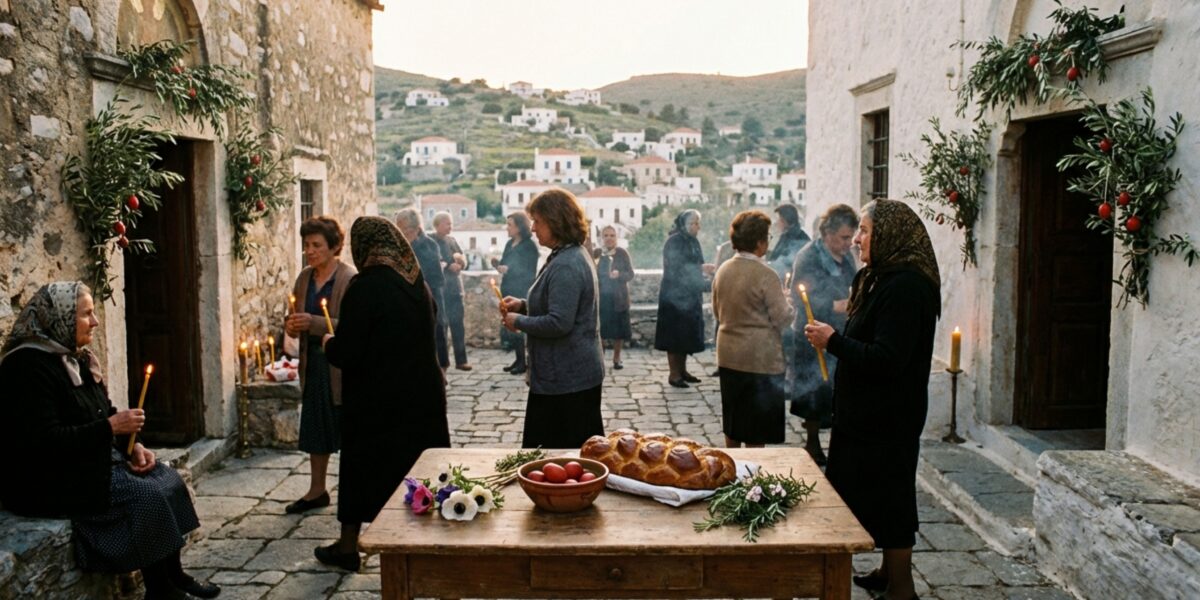
Easter in Greece is not simply a public holiday.
It is the single most significant event in the Greek Orthodox calendar, and it shapes the rhythm of the entire spring on the island of Crete and across the country. Villages empty of their city residents, church courtyards fill with candlelight at midnight, and family tables stay set for most of the day. If you happen to be in Greece during Holy Week, you are witnessing something that has remained largely unchanged for centuries.
This guide walks you through the key dates, the rituals of Holy Week, the foods that appear only at this time of year, and what makes celebrating Easter in Crete a distinct experience from the rest of the country.
| Quick Answer
Easter in Greece (Pascha) falls on Sunday, April 12 in 2026 for Orthodox Christians. The celebration spans the full week before Easter Sunday, known as Holy Week. Key moments include the Good Friday Epitaphios procession, the midnight Resurrection service (Anastasi) on Holy Saturday, and Easter Sunday lamb feasts. The Orthodox date differs from Western Easter because it follows the Julian calendar and is always celebrated after the Jewish Passover. |
What Is Greek Easter and When Does It Fall?
Easter in Greece follows the Greek Orthodox Church calendar, which calculates the date differently from the Western Christian tradition. The Orthodox Easter date is determined using the Julian calendar, not the Gregorian one used by Catholic and Protestant churches. This means Greek Easter usually falls one to five weeks after Western Easter, though in some years the dates align.
In 2026, Greek Orthodox Easter Sunday falls on April 12. Holy Week begins on Palm Sunday, April 5, and runs through Easter Monday, April 13, which is also a public holiday in Greece.
Greeks refer to Easter as Pascha (Πάσχα). Holy Week is called Megali Evdomada, meaning Great Week. The period leading up to it includes 40 days of Lent (Sarakosti) starting from Clean Monday, and before that, three weeks of the carnival season known as Apokries.
Holy Week in Greece: A Day-by-Day Guide
Each day of Holy Week carries its own rituals and significance. This is not a week when Greece simply counts down to Sunday. The services, the preparations, and the atmosphere build slowly, so that by midnight on Holy Saturday, the release of emotion is genuine.
Palm Sunday
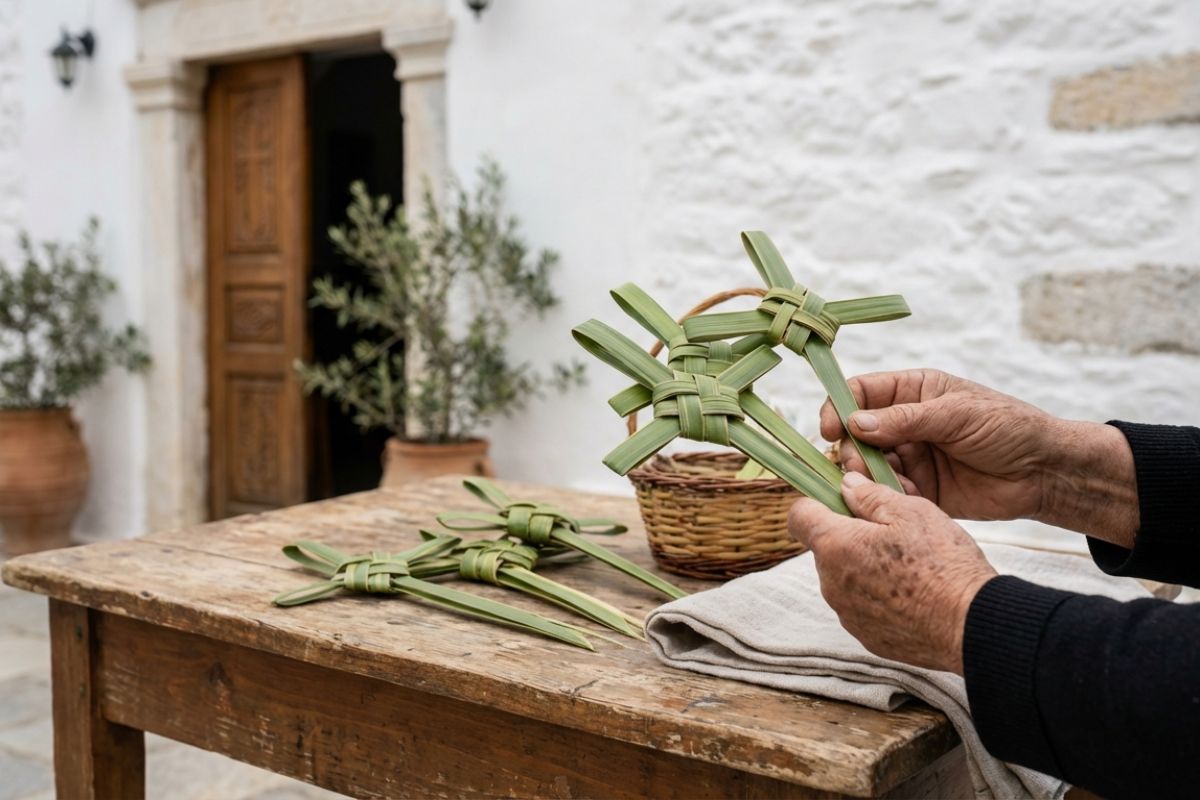
Holy Week opens with Palm Sunday. Families attend morning church services holding woven palm crosses and olive branches, which are blessed and taken home to place in the family iconostasis, a small domestic altar. In Crete, these palm crosses are handmade from date palm fronds, a craft passed down across generations.
Holy Monday Through Holy Wednesday
The early days of the week are quieter, marked by evening church services that grow more solemn with each passing day. Households begin preparations: women bake tsoureki (the sweet braided Easter bread), dye eggs red, and in Crete, prepare kalitsounia, the island’s traditional soft-cheese pastries that appear only at this time of year. Village bakers work through the night. Children collect wood for Saturday bonfires.
Holy Thursday
On Holy Thursday, the Twelve Gospels are read during an evening service that can last several hours. All church lights are extinguished after the sixth gospel, and a cross is carried through the darkness. This is among the most atmospheric services of the week. Red eggs are traditionally dyed on this day, symbolizing the blood of Christ.
Good Friday (Megali Paraskevi)
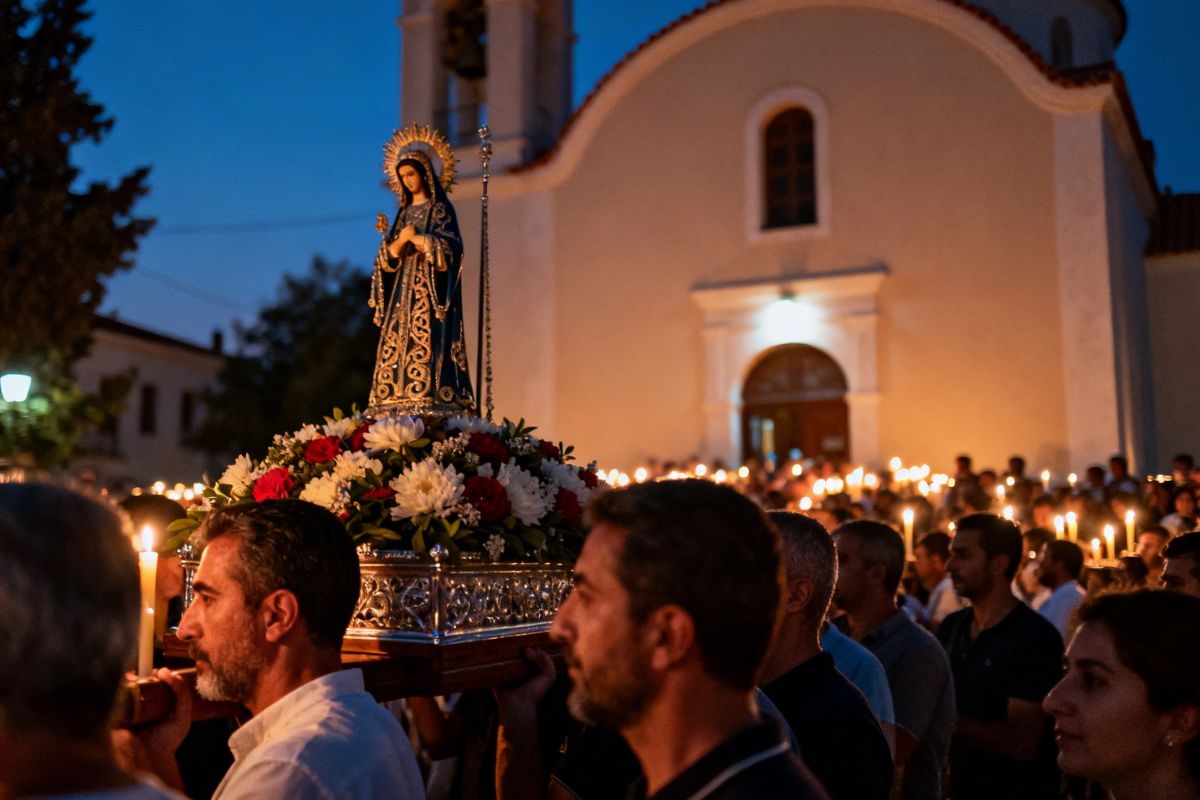
Good Friday is a day of genuine mourning across Greece. Church bells ring slowly throughout the morning. Shops and tavernas close in many areas. During the day, women and children decorate the Epitaphios, a wooden bier representing the tomb of Christ, covering it with flowers. In the evening, the decorated Epitaphios is carried through the streets in a candlelit procession, with the congregation dressed in black and following behind in silence. It is a striking thing to witness. In Crete, as elsewhere, this is one of the most attended and emotionally charged moments of the year.
Holy Saturday and the Midnight Anastasi
Holy Saturday is the day of last preparations. Magiritsa, the traditional lamb offal soup served after midnight, is prepared. Special candles are bought. Villages come alive with the smell of wood smoke as children build bonfires in the church forecourts, placing an effigy of Judas on top, ready to burn.
From 11 pm onward, people gather at every church across the island and the country. The interior is dark. Just before midnight, the priest emerges holding a single lit candle, the Holy Flame, brought to Greece from the Church of the Holy Sepulchre in Jerusalem. He announces Christos Anesti, Christ is Risen, and passes the flame from candle to candle until the entire courtyard is lit.
Fireworks go off. Judas effigies burn. Church bells ring. People greet each other with “Christos Anesti” and respond “Alithos Anesti” (He is truly risen). Many try to carry their candle home still lit, making the sign of the cross in soot above the front door as a blessing. The fast ends at midnight, and magiritsa follows immediately.
Easter Sunday
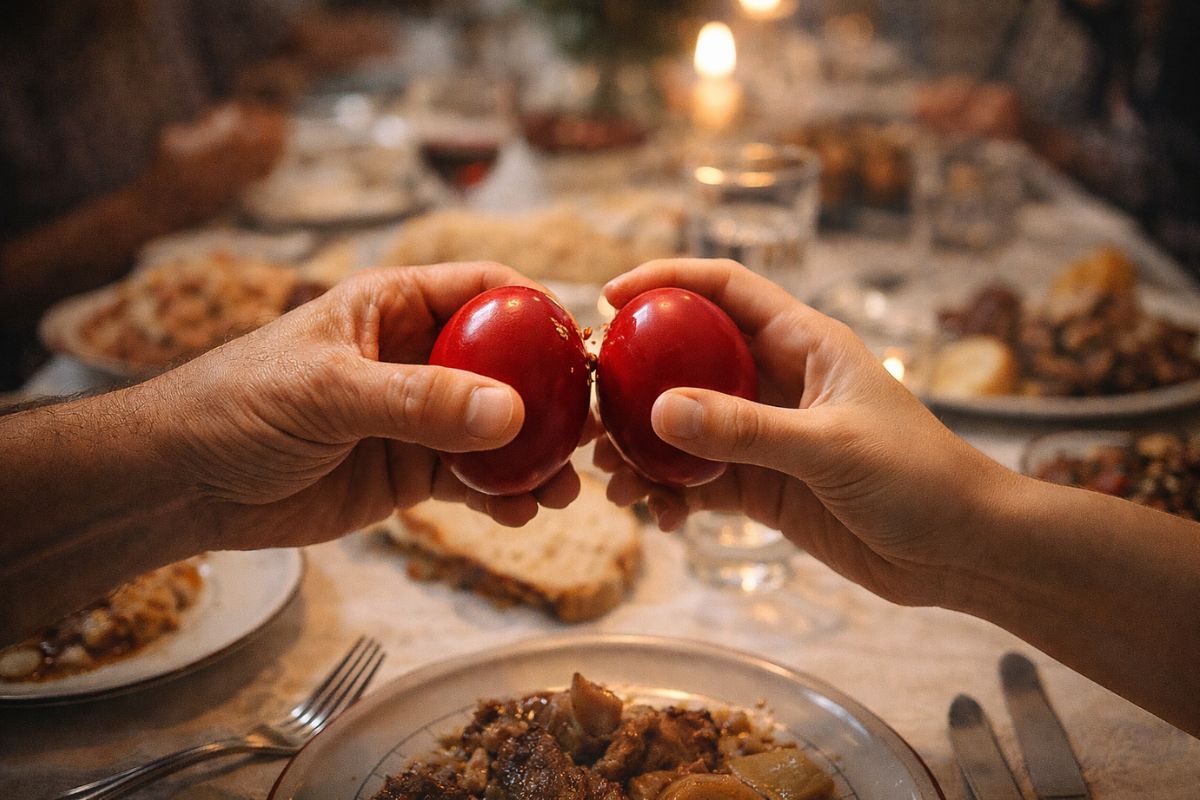
Easter Sunday begins early. By 8 am, families have already lit fires and secured whole lambs on spits over charcoal or grapevine wood. The lamb turns slowly for hours. Tables are set outdoors whenever the weather allows. Red eggs appear, and the tsougrisma game begins: two people each hold an egg and crack them together. Whoever has the last uncracked egg is said to have good luck for the year. Food, music, raki, and dancing continue well into the evening.
Greek Easter Traditions You Will Actually See
Beyond the church services, several specific traditions define the Easter period across Greece. These are the moments visitors tend to remember most.
- The Epitaphios procession on Good Friday evening: solemn, candlelit, and attended by entire communities, including people who rarely attend church at other times of year.
- The midnight Anastasi on Holy Saturday: the single most emotionally significant moment of the Greek Orthodox calendar, combining religious ceremony, fireworks, and an overwhelming sense of collective release.
- The Judas burning in Crete and parts of mainland Greece: village bonfires with an effigy of Judas Iscariot burned at midnight, a custom that varies significantly from village to village in scale and spectacle.
- Tsougrisma (egg cracking): a competitive game played at every Easter table using the hard-boiled red eggs.
- The candle walk home: after the midnight service, people walk or drive with their lit candle, attempting to arrive home with the flame still burning.
What to Eat at Easter in Greece
Greek Easter is inseparable from its food traditions. The 40-day Lenten fast means that the feast that follows carries real weight. These are the dishes that define the season.
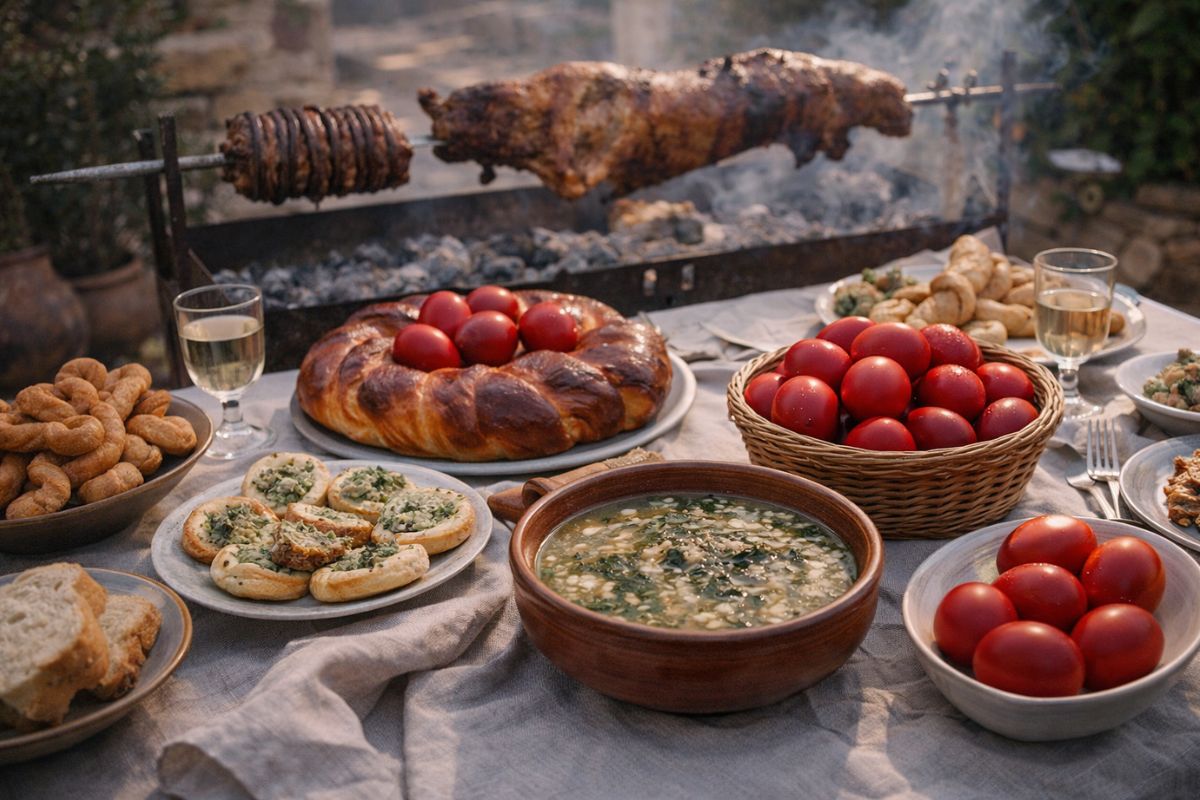
- Magiritsa: a soup made from lamb offal, rice, dill, and lemon-egg sauce, eaten at midnight after the Anastasi service to break the fast. It is an acquired taste but a deeply traditional one.
- Spit-roasted lamb (souvla): the centerpiece of Easter Sunday, prepared outdoors over charcoal. The whole animal turns on the spit for four to six hours, often accompanied by kokoretsi, seasoned lamb intestines wrapped around offal and roasted alongside it.
- Tsoureki: a soft, braided sweet bread flavored with aromatic spices including mahlep and mastic. The three braids represent the Holy Trinity. Red eggs are often baked into the dough or placed on top.
- Red eggs: hard-boiled eggs dyed red, symbolizing the blood of Christ and the resurrection. They appear on every Easter table and are used in the tsougrisma game.
- Koulourakia: buttery Easter cookies, often twisted into braided shapes, baked in large batches and shared with neighbors and guests.
- Kalitsounia (in Crete): small open-faced pastries filled with sweetened mizithra cheese or a combination of cheese and wild herbs. These are specific to Crete and made only during Easter week and springtime. They are worth seeking out if you visit the island at this time.
Easter in Crete: A Celebration With Its Own Character
Easter across Greece shares the same religious framework, but each island and region adds its own layer of custom. Crete, more than most places, holds onto its local traditions with particular intensity. If you are deciding where to spend Easter in Greece, Crete offers something genuinely distinctive.
A popular Cretan saying goes: “No one should be alone at Easter.” This is not a formality. If you are walking through a village on Easter Sunday and someone is celebrating outside, there is a good chance you will be called over to eat. Cretan hospitality at Easter operates at a different register than any other time of year.
The Judas bonfire tradition is especially vivid in Cretan villages. Children spend much of Holy Saturday building and competing over who will have the largest fire and the most convincing effigy. By midnight, the sky above village churches is bright with fireworks and flame. The effect is extraordinary when you are watching it from a hillside church with the Aegean below.
The food on Crete at Easter also carries the island’s agricultural identity. The lamb used for Easter Sunday almost always comes from local farms. The kalitsounia are made at home from local mizithra, and the herbs in the filling, often fresh wild fennel or mint, are picked from the land around the house. The lyra and the tsibouli (traditional flute) provide the music. If you want to understand how Cretan culture expresses itself through landscape, food, and collective ritual, Easter is the most concentrated opportunity of the year.
For those curious about the longer arc of sacred tradition in Crete, the island’s relationship with cyclical time and seasonal ritual runs far deeper than the Christian calendar. Crete’s landscape carries the memory of older layers of sacred practice, including the Minoan world that preceded it by millennia. If that interests you, exploring the Minoan sacred year through its own lens is a natural companion to experiencing how the island marks the turning of spring today.
Practical Tips for Visiting Greece at Easter
Easter is one of the busiest travel periods in Greece, particularly on the islands and in historic towns. A few practical points are worth knowing before you plan your trip.
- Book accommodation early. Greek families return to their home villages and islands for Easter, which means accommodation in popular destinations fills up weeks or months in advance.
- Expect reduced services. Many shops, tavernas, and businesses close on Good Friday and may operate limited hours through Easter Monday. This is especially true in smaller towns and villages on Crete.
- Attend the midnight service. You do not need to be Orthodox Christian to attend the Anastasi. Dress modestly, arrive by 11 pm to find a place, and be respectful of the service. The atmosphere is unlike anything in mainstream tourism.
- Go to the villages. The most authentic Easter experiences in Crete are in smaller communities, not in tourist-facing resort towns. If you can reach a working village for the Easter celebrations, the experience is far richer.
- Weather in April. Spring in Crete is generally mild, with temperatures between 15 and 20 degrees Celsius. Evenings can be cool, so bring a layer for the midnight service outdoors.
- Driving on Easter Sunday. Roads can be busy in the morning hours as families travel between villages. Allow extra time if you are moving between towns on Easter Sunday.
Conclusion
Easter in Greece is the country at its most itself. The combination of deep religious sincerity, communal generosity, and unrestrained celebration produces something that is genuinely difficult to find elsewhere. If you are planning a spring trip to Crete and the dates align, building your visit around Holy Week is a decision you will not regret.
The island’s Easter has a particular intensity, shaped by strong village traditions, distinctive foods, and a landscape that seems designed for the occasion: hillside churches, spring wildflowers, sea views from every promontory. Whether you follow the full Holy Week or simply arrive for Easter Sunday, the island gives you something to take home beyond photographs.
For a deeper sense of Crete’s cultural life beyond the Easter season, the island’s traditional villages, its ancient sites, and its long relationship with sacred landscape offer many more layers to explore throughout the year.

Frequently Asked Questions About Easter in Greece
When is Easter in Greece in 2026?
Greek Orthodox Easter in 2026 falls on Sunday, April 12. This is one week after Western Easter (April 5). Holy Week runs from Palm Sunday, April 5, through Easter Monday, April 13.
Why is Greek Easter on a different date than Western Easter?
The Greek Orthodox Church calculates Easter using the Julian calendar rather than the Gregorian calendar used by Catholic and Protestant churches. Orthodox tradition also maintains that Easter must fall after the Jewish Passover. The result is that Greek Easter usually falls one to five weeks later than Western Easter, though occasionally the dates coincide.
What happens at the midnight Anastasi service?
The Anastasi is the Resurrection service held at midnight on Holy Saturday. Churches are filled and the lights are extinguished just before midnight. A priest then appears with the Holy Flame, passed from candle to candle through the congregation. At midnight, the priest declares “Christos Anesti” (Christ is Risen), and the crowd responds “Alithos Anesti” (He is truly risen). Fireworks, church bells, and celebrations follow immediately.
What are the main Easter foods in Greece?
The main Easter foods include magiritsa (lamb offal soup eaten after the midnight service), spit-roasted lamb on Easter Sunday, tsoureki (sweet braided bread), red-dyed hard-boiled eggs, and koulourakia (Easter cookies). In Crete, kalitsounia (soft cheese pastries) are a local specialty made specifically for Easter week.
Is Easter a good time to visit Crete?
Easter is an excellent time to visit Crete if you are interested in local culture and traditional celebration. The weather is mild, the island is green with spring wildflowers, and the Easter rituals in Cretan villages are among the most authentic you can experience in Greece. Accommodation books up early, so plan ahead. Many tavernas and shops operate reduced hours during Holy Week.
Can tourists attend Easter church services in Greece?
Yes. The Anastasi midnight service and the Good Friday Epitaphios procession are open to everyone. You do not need to be Orthodox to attend. Dress modestly, arrive early to find a good position, and observe the service respectfully. Photography during the service itself should be approached carefully and kept unobtrusive.